
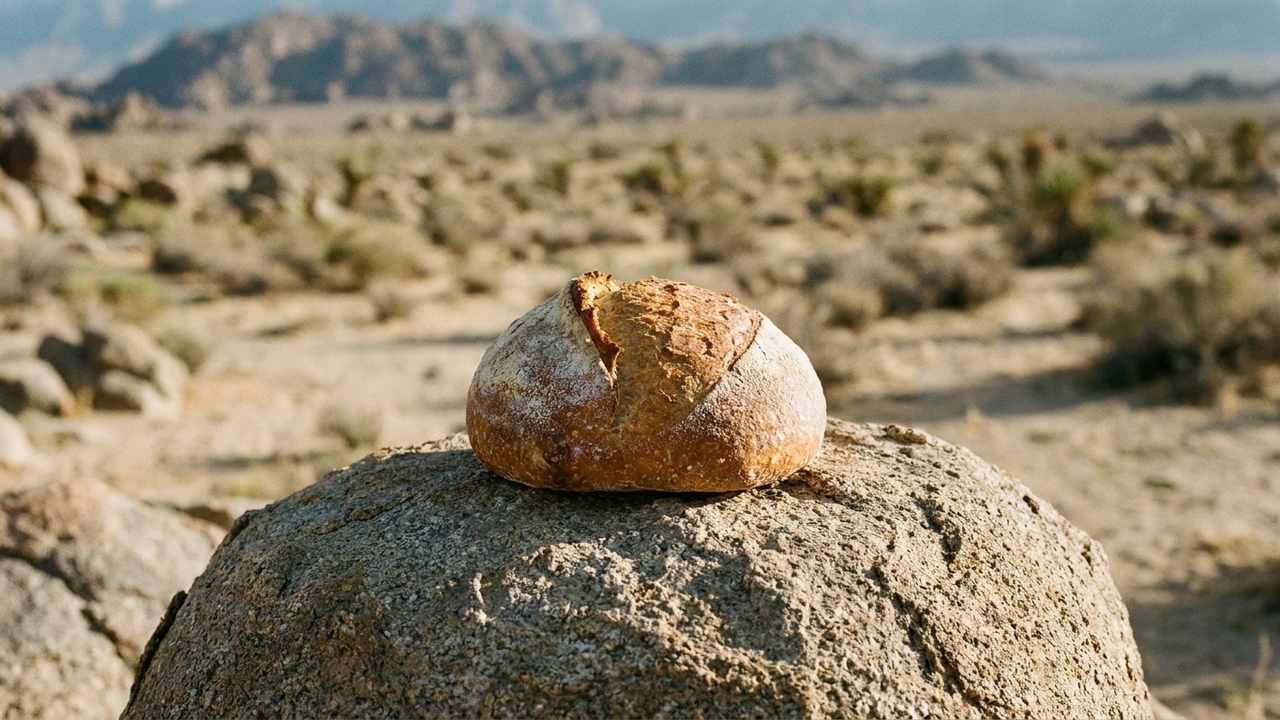
The three temptations of Jesus are a three-part wilderness test recorded in the Gospels of Matthew and Luke, and they symbolize three archetypal human pressures: appetite, spectacle, and power. In the story, Jesus fasts for forty days in the desert and then faces three offers — turn stones into bread, leap from the temple roof, and take command of all the world’s kingdoms. Each offer is a shortcut, and each one is refused with a line from Deuteronomy. When readers ask what do the 3 temptations of jesus symbolize, they are really asking what these three scenes reveal about hunger, faith, ambition, and the way human beings are tested when they are tired, lonely, or certain of their own importance.
This matters because the three temptations have traveled far beyond the pulpit. They appear in early church theology, in monastic training manuals, in Dostoevsky’s fiction, in Milton’s poetry, and in modern leadership writing about quick fixes and shortcuts. The symbols are flexible enough to carry personal meaning (the diet you break at midnight), spiritual meaning (the prayer you demand instead of trust), and social meaning (the empire you admire). Below, each temptation gets its own full reading, followed by how different traditions interpret the three, why the number three matters, the differences between Matthew and Luke, the most common misunderstandings, and answers to the questions readers ask most.
The Core Symbolism: What the Three Temptations Represent
The three temptations represent a single test applied to three different parts of human desire: the body’s need for comfort, the ego’s need for recognition, and the will’s need for control. The three temptations symbolize the three classic shortcuts to a good life — satisfy yourself, impress others, and seize power — and Jesus refuses all three in favor of trust, humility, and allegiance to God. The story is not mainly about minor sins. It is about the direction of a whole life.
Each scene follows the same structure. The tempter proposes an action, usually with a reasonable-sounding justification, and Jesus answers with Scripture that reorders the priority. Bread is answered with the word of God. The temple leap is answered with a command not to test God. The kingdoms are answered with exclusive worship. The pattern makes the symbolism clear: every temptation offers something good (food, safety, authority) and asks for something wrong (distrust, presumption, idolatry).
Across all three scenes, several threads run consistently:
- Shortcut versus path: each offer skips the hard, slow route — suffering, obscurity, service — and jumps straight to the result.
- Identity under attack: twice the tempter begins with “If you are the Son of God,” turning vocation into a dare rather than a gift.
- Scripture as a counter-argument: Jesus does not debate or negotiate; he answers each offer with a settled text, mostly from Deuteronomy.
- The wilderness setting: the desert is the classic biblical place of testing, formation, and clarity, not punishment.
- An unfinished story: Luke ends the scene by noting the devil left “until an opportune time,” suggesting the test returns in other forms.
The core symbolism, then, is diagnostic rather than decorative. The three scenes give readers a vocabulary for naming the pressure they are under at any given moment: is this a hunger issue, a reputation issue, or a control issue?
Bread, Stones, and Hunger: What the First Temptation Symbolizes
The first temptation symbolizes the pull of immediate physical satisfaction and the urge to use power for personal comfort. After forty days of fasting, the tempter points at the stones on the desert floor and says, in effect, “If you are who you say you are, make these into bread.” The stones of the Judean wilderness are famously bread-colored — round, smooth, limestone chunks that look exactly like loaves from a distance. The offer is not ridiculous. It is reasonable, which is what makes it a temptation.
The surface meaning: appetite and self-provision
On the surface, the symbol is hunger. Jesus is genuinely starving, and the request touches a real bodily need rather than a manufactured craving. The temptation is to treat divine power as a personal pantry — to convert a gift into a convenience. Bread here stands for every legitimate need that we want satisfied on our own terms and on our own schedule: the paycheck, the comfort, the relief, the fix.
The deeper meaning: Israel, manna, and daily dependence
Jesus answers with Deuteronomy 8:3, a verse about Israel wandering in the desert and receiving manna one day at a time. That reference unlocks the symbolism. Israel’s forty years in the wilderness become Jesus’s forty days, and the failure of the first wilderness generation becomes the backdrop for the second. Bread is not just food; it is the test of whether a person can trust a daily provision instead of hoarding, controlling, or manufacturing their own.
The first temptation carries several layers of meaning that interpreters have identified over the centuries:
- Appetite: the body’s demands, and the assumption that any hunger must be fed immediately.
- Distrust of providence: the belief that God’s ordinary provision is not enough and that we must take matters into our own hands.
- Misused power: the conversion of a gift into a tool for self-service rather than service to others.
- Spiritual versus material: the reminder that humans do not live on bread alone — meaning both that bread is not enough and that bread is not nothing.
- Social hunger: in liberation theology, bread also stands for real, physical hunger, and the refusal to turn stones into bread is read alongside the command to feed the hungry by other means — through justice rather than magic.
A practical illustration makes the symbolism concrete. A skilled professional with a rare talent is offered a lucrative contract that requires her to shade the truth slightly. Nothing about the work is illegal, and the money solves genuine problems at home. That is the first temptation in modern dress: a real need, a real ability, and a shortcut that quietly rearranges her loyalties. The bread is not evil. The question is what she is willing to become in order to eat.
The Temple Pinnacle: What the Second Temptation Symbolizes
The second temptation symbolizes presumption — the use of faith as a performance and the demand that God prove himself on cue. The tempter sets Jesus on the highest point of the temple in Jerusalem and quotes Psalm 91: “He will command his angels concerning you, and they will lift you up in their hands.” The logic is airtight on paper: Scripture promises protection, so a public leap should produce a public rescue. It is the oldest trick in religious argument — quote the promise, ignore the context, and call the result faith.
Interpreters have read the pinnacle scene in several distinct ways, and the differences are worth setting side by side:
| Reading | What the pinnacle symbolizes | Who tends to emphasize it |
|---|---|---|
| Spectacle | Faith turned into a show, where the point is the audience rather than the truth | Preachers writing about religious showmanship |
| Presumption | Demanding that God act on our schedule, testing him rather than trusting him | Classical theology and devotional writing |
| Sign-seeking | The craving for proof before commitment, the opposite of faith | Gospel studies and catechesis |
| Spiritual pride | The illusion of special status that makes someone feel exempt from ordinary limits | Monastic and desert tradition |
| Religious power | Control exercised through the sacred center of a society | Social and political readings |
Why the temple roof mattered
The temple was the economic, political, and religious heart of Jewish life, and its roof edge — the Greek word suggests a wing or parapet — was a place where a dramatic descent would be seen by crowds in the courtyard below. The symbolism is location-specific: this is not a private test in the desert but a public stunt at the center of national identity. To leap would be to force God’s hand in front of everyone, converting trust into theater.
The Scripture-quoting tempter
One of the most unsettling details in the whole story is that the tempter quotes the Bible. That detail gives the second temptation its sharpest modern edge: religious language can be used to justify recklessness. Anyone who has watched a destructive decision defended with a verse knows what this scene symbolizes. The response Jesus gives — “Do not put the Lord your God to the test” — comes from Deuteronomy 6:16, a verse that recalls Israel demanding water at Massah and doubting whether God was present at all.
The Kingdoms of the World: What the Third Temptation Symbolizes
The third temptation symbolizes idolatry in its most polished form: power offered at the price of allegiance. The tempter shows Jesus all the kingdoms of the world and their splendor and offers them in exchange for a single act of worship. This is the most naked of the three offers, because it removes the disguise. Bread appealed to the stomach, the pinnacle appealed to reputation, but the kingdoms appeal to the will — and they ask for worship, not merely obedience.
Consider a scenario. A reformer joins an institution determined to change it from within. Within a year, a senior figure offers her the top job, on one condition: she stops criticizing the system publicly and publicly praises the people she once condemned. The promotion is real, the influence would be real, and the cost is a single bow. That is the third temptation, and it is the one most likely to arrive when a person is at the height of their usefulness.
The symbolism of the kingdoms works on several levels:
- Political power: the kingdoms represent Rome, Herod, and every empire that promises order in exchange for loyalty.
- Compromise: the offer implies that the ends justify the means, and that a good ruler can be installed by a bad act.
- Idolatry: worship is the hinge of the scene; the real question is not who governs but who is God.
- The shortcut to messiah: Jesus’s mission was to reign, and the temptation offers the destination without the cross.
- Everyday ambition: the “kingdoms” can be a career, a platform, a family, or a reputation — any good thing that becomes the thing.
Worship as the real issue
The third temptation clarifies what the first two were building toward. Bread and spectacle are about what a person wants; the kingdoms are about who a person serves. Jesus answers with Deuteronomy 6:13, “Worship the Lord your God, and serve him only,” which places the entire story inside the first commandment. The symbol, then, is not simply “don’t be ambitious.” It is “ambition must have a rightful owner.” Power is not rejected in the story — it is refused at that price, from that hand, by that route.
How Different Traditions and Cultures Read the Symbols
The three temptations carry different weights in different traditions, and the meanings shift noticeably from one context to another. Some readers see a moral map for the individual soul, others see a political drama about empire, and others see a literary masterpiece about human freedom. Stating those differences plainly is important, because a single “official” meaning does not exist.
| Tradition or context | Emphasis | What the three symbols mean there |
|---|---|---|
| Early church fathers | Recapitulation | Jesus succeeds where Adam and Israel failed, reversing the first human temptation in a wilderness instead of a garden |
| Desert and monastic spirituality | Spiritual warfare | The three scenes become a training pattern for resisting temptation through fasting, Scripture, and watchfulness |
| Medieval Western theology | Threefold concupiscence | The temptations map onto the lust of the flesh, the lust of the eyes, and the pride of life from 1 John 2:16 |
| Eastern Orthodox practice | Ascetic formation | The forty-day fast becomes the model for Lent and for the slow reshaping of desire |
| Jewish reading of the wilderness | Israel’s story | The tests echo Israel’s forty years: hunger, testing at Massah, and the lure of foreign gods |
| Liberation theology | Social and economic | Bread names real hunger; the kingdoms name real empires; the refusal is a critique of power without justice |
| Literary culture | Human freedom | Dostoevsky’s Grand Inquisitor reads the three offers as bread, miracle, and authority — the three forces that move masses of people |
| Modern leadership writing | Integrity | The scenes become lessons about quick wins, hype, and compromised authority |
Two contrasts deserve emphasis. First, the same scene can be read as a personal moral lesson or as a public critique of empire, and both readings have ancient support. Second, the “order” of the temptations differs between Gospels, which means even the sequencing carries meaning rather than being fixed. In Milton’s Paradise Regained, the temptations become the central structure of an entire epic, with the wilderness as the battlefield where the first Adam’s defeat is undone.
It is also worth noting that not every culture reads the story as a drama between Jesus and a personal devil. Some readers treat the tempter as an internal voice, others as a literary device, and others as a real adversary. The symbolism of appetite, spectacle, and power survives all three readings, which is part of why the text keeps being used.
Why Three Temptations, and Why the Order Changes
The number three symbolizes completeness and decisive testing in biblical literature, and the change of order between Matthew and Luke shows that each Gospel writer arranged the scenes to make a specific point. Three is the number of a finished case: a matter is established by two or three witnesses, a test is repeated three times, and a story reaches its fullness at the third beat. The temptations are not a random sample of sins; they are a complete sweep of human desire.
Several reasons explain why the count and sequence matter:
- Completeness: three covers the body, the reputation, and the will — nothing is left outside the test.
- Pattern recognition: the repetition lets readers see the underlying method rather than only the individual offers.
- Echo of Israel: the wilderness generation was tested repeatedly, and the three scenes condense that history into a single confrontation.
- Literary climax: in Matthew, the sequence rises from personal need to public spectacle to global power, ending on a mountain that anticipates the final resurrection mountain.
- Theological emphasis: in Luke, the sequence ends at the temple in Jerusalem, the city where the Gospel’s story will reach its crisis.
The order difference is not a contradiction to be explained away; it is an editorial choice. Matthew builds toward the mountain of kingdoms, which fits his concern with authority and the kingdom of heaven. Luke moves the temple test to the end and follows it with the note that the devil departed “until an opportune time,” which fits his interest in Jerusalem and in the ongoing nature of the conflict. Both arrangements preserve the same three symbols, but the emotional landing point differs.
Common Misconceptions and What the Text Actually Says
Popular retellings produce several misconceptions about the three temptations, and correcting them sharpens the symbolism considerably. The most common error is to shrink the story into a list of three bad habits, when the text is actually about vocation, identity, and worship.
| Common misconception | What the story actually suggests |
|---|---|
| The temptations were about ordinary sins like gluttony or pride | Each offer targets Jesus’s mission, not just his manners: who provides, who is trusted, and who is worshiped |
| The devil is a cartoon villain who makes obviously evil offers | The offers are attractive and scripturally argued; the second one quotes Psalm 91 |
| Resisting temptation is a matter of willpower | Jesus answers with settled Scripture, and the scene opens with the Spirit leading him into the wilderness |
| The story is only about Jesus and has no application | The wilderness pattern became the model for Lent, monastic formation, and everyday discernment |
| The temptations ended in the desert | Luke says the devil left “until an opportune time,” implying the test returns in new forms |
| Refusing the kingdoms means power is evil | The refusal is about the price and the source, not about rejecting responsibility altogether |
Another frequent confusion concerns the phrase “If you are the Son of God.” Some readers hear it as a denial; others hear it as a sneer. In the original language, the construction can carry the sense of “since you are,” which makes the temptation sharper: the point is not to doubt identity but to exploit it. That single detail changes how the whole story reads, because the pressure is not “become someone” but “use who you already are for the wrong purpose.”
Frequently Asked Questions
What are the three temptations in order?
In Matthew the order is bread from stones, the pinnacle of the temple, and the kingdoms of the world. In Luke the order is bread, then kingdoms, then the pinnacle. The three offers are identical; only the sequence changes.
What does each temptation symbolize in one sentence?
Bread symbolizes appetite and the demand for immediate satisfaction. The pinnacle symbolizes presumption and the use of faith as spectacle. The kingdoms symbolize power and the idolatry of control. Together they cover the body, the ego, and the will.
Why did Jesus fast for forty days?
The number forty echoes Israel’s forty years in the wilderness, Moses’s forty days on the mountain, and Elijah’s forty days on the journey to Horeb. Fasting sets up the test: the point is that a person at the edge of endurance is still capable of faithfulness.
Did the devil really show him all the kingdoms of the world?
The text says he showed them “in an instant,” which suggests a vision rather than a physical vantage point — no mountain on earth offers a view of every empire. The symbolic force does not depend on geography: the offer is real, and the splendor is real.
How do the three temptations connect to 1 John 2:16?
Many interpreters map the scenes onto the lust of the flesh, the lust of the eyes, and the pride of life. The mapping is traditional rather than explicit in the text, and different writers assign the scenes slightly differently, but the three-part structure of desire is the same.
What does the threefold pattern teach a beginner?
A useful starting point is to ask three questions when facing a decision:
- Is this meeting a real need, or is it feeding a craving I have not examined?
- Am I trusting, or am I demanding a sign to prove I am special?
- What am I worshiping in exchange for what I am gaining?
Conclusion: Why the Three Symbols Still Matter
The three temptations of Jesus symbolize a complete map of human pressure, and the map has not aged. Bread still stands for the legitimate need we want met on our own terms. The pinnacle still stands for the desire to be seen, proven, and admired rather than simply trusted. The kingdoms still stand for the good thing that becomes the ruling thing. The story refuses all three shortcuts and insists that trust, humility, and right allegiance are not obstacles to a full life but the shape of one.
That is why the scene has been reinterpreted by monks, mystics, novelists, and management writers for two thousand years: it is short, spare, and endlessly deep. Readers who understand the symbolism gain more than a piece of religious trivia. They gain a diagnostic tool they can use on a Tuesday afternoon when an offer arrives that is just a little too convenient.
Three takeaways are worth carrying forward:
- The offer is rarely ugly; temptation usually arrives dressed as a reasonable solution.
- The counter-argument is rarely clever; in the story, settled conviction beats a clever quote.
- The question is never only what you want, but who gets to be worshiped in the process.
Read the wilderness story again with those three lenses, and the ancient desert stops feeling distant. It becomes a mirror, and a surprisingly practical one.