
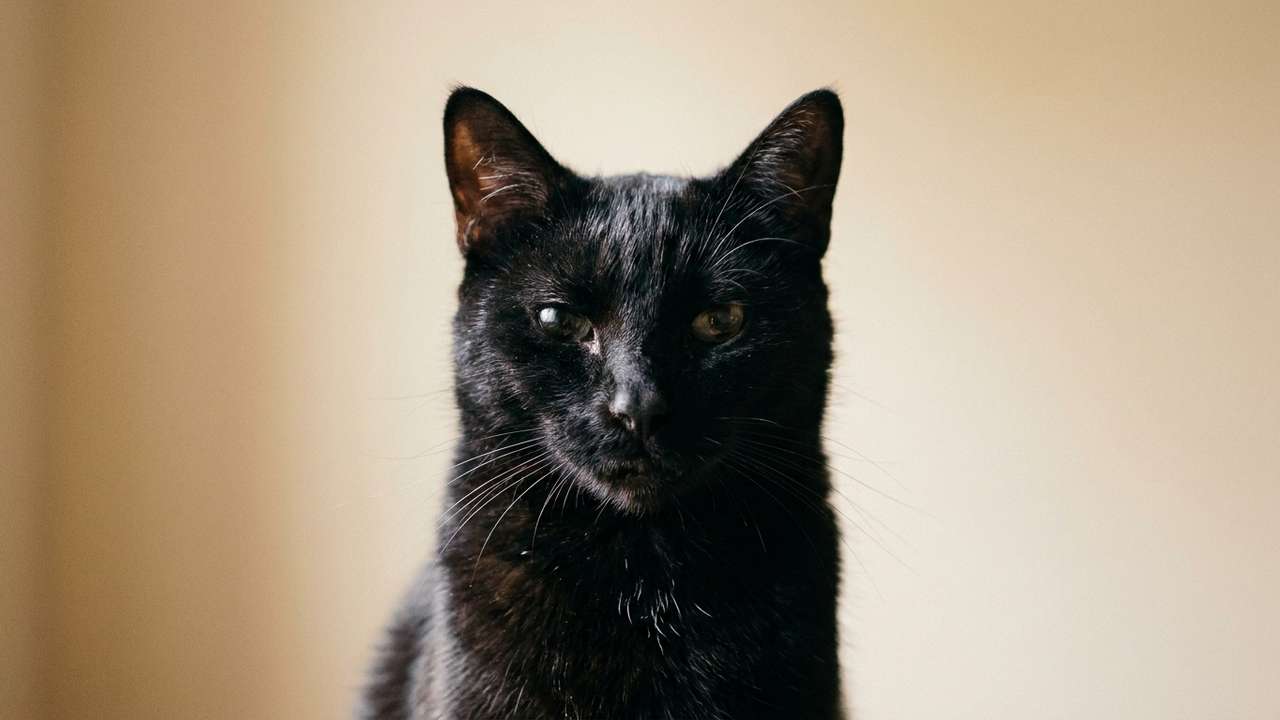
A black cat symbolizes good luck, protection, and mystery in most English-speaking countries, yet the very same animal signals bad luck, witchcraft, and misfortune in much of Europe and Russia. That single contradiction is the heart of the topic. When someone asks what does a black cat symbolize, the honest and accurate answer depends on where the question is asked, when it is asked, and who is answering.
Black cats sit at a strange crossroads of human culture. They appear in ancient Egyptian temples, Norse mythology, Japanese shop windows, Scottish porches, German village lanes, and modern animal shelters. They have been worshipped, feared, protected, and persecuted, sometimes within the same century. This guide walks through the core meanings first, then moves through cultural variations, the historical origins of the superstition, spiritual and religious readings, real-life situations, physical variations, and the most common misconceptions, so you leave with a complete picture instead of a one-line answer.
The Meaning of a Black Cat: Core Symbolism at a Glance
A black cat is an animal whose symbolic value rests almost entirely on luck, protection, and the supernatural. The most important attribute of a black cat in the English-speaking world is good fortune. British, Scottish, and American traditions frequently treat a black cat as a lucky charm, while Continental European and Russian traditions treat it as a warning. That split is the single most useful fact to hold onto before diving into the details.
A black cat symbolizes good luck, protection, and mystery in most English-speaking countries, but bad luck and dark magic in several European and Russian traditions. Everything else in this article is a variation on that core idea.
The most common symbolic meanings attached to black cats around the world include:
- Good luck and prosperity, especially in Britain, Scotland, and Japan
- Protection from evil, particularly in Japanese and Chinese folklore, where a black cat guards a home from bad spirits
- Mystery and the unknown, because a black coat hides a cat’s expression and makes it seem to appear and disappear
- Magic and witchcraft, a meaning that grew out of medieval European persecution
- Independence and self-reliance, a modern reading tied to the cat’s solitary nature
- Bad luck and misfortune, the dominant meaning in Russia, Eastern Europe, and parts of Germany
- Death and endings, a darker folk belief found in a few regional traditions
- Rebellion and quiet elegance, a contemporary pop-culture reading that treats the black cat as an underdog
Good Luck or Bad Luck? Why Both Answers Are Correct
A black cat carries opposite meanings in different regions because the superstition developed separately in each place. In Britain, a black cat crossing your path from left to right is a good omen, and many people still say “lucky black cat” without thinking twice. In Russia and much of Eastern Europe, a black cat crossing your path is treated as a bad sign, and some people will change direction or wait for someone else to walk first.
The key point is that neither tradition is the “real” one. Folk beliefs are local, and the black cat simply inherited two different reputations in two different parts of the world.
What a Black Cat Symbolizes in Cultures Around the World
A black cat’s meaning changes dramatically from country to country, and the differences are not small details. In Japan, a black cat is a protective lucky charm. In Germany, the meaning can flip based on which direction the cat walks. In Egypt, the animal connects back to a goddess. The table below summarizes the most widely documented traditions.
| Country or Region | Traditional Meaning | Details |
|---|---|---|
| Great Britain | Good luck | A black cat crossing your path from left to right is considered lucky; the “lucky black cat” is a common phrase |
| Scotland | Prosperity | A strange black cat arriving on your porch is said to signal coming wealth |
| Japan | Good luck and protection | Black cats are believed to ward off evil and are also said to help single women attract suitors |
| China | Good fortune and guardianship | The black cat is treated as a guardian that can drive away bad spirits and bring luck |
| Germany | Depends on direction | In many German traditions a cat crossing from right to left is unlucky, while the reverse is lucky; some regions reverse it again |
| Russia and Eastern Europe | Bad luck | A black cat crossing your path is a negative omen, and pregnant women were traditionally warned to avoid them |
| Italy | Mixed | Hearing a black cat sneeze is considered lucky in some Italian traditions, while other regional beliefs treat black cats with caution |
| Ancient Egypt | Reverence | Cats were sacred and linked to the goddess Bastet; harming a cat was a serious offense |
| Norse Scandinavia | Sacred and magical | The goddess Freyja was said to ride in a chariot pulled by cats, tying felines to love, magic, and fertility |
| United States | Mixed and spooky | Halloween imagery dominates, so many Americans read a black cat as a symbol of Halloween rather than of luck |
| Sailor and pirate folklore | Good luck at sea | A black cat walking toward you was lucky, and a black cat walking away was not; some fishermen’s wives kept black cats for a husband’s safe return |
Notice how often the direction of the cat decides the meaning. That detail matters more than the color in several traditions, which is why two people in the same town can disagree about whether black cats are lucky.
Why the Same Animal Means Opposite Things
The split comes down to two separate cultural currents. In maritime Britain, Japan, and China, cats earned their reputation as workers that protected stored grain and cargo from rodents, so a black cat became a lucky companion. In medieval continental Europe, cats became tangled up with accusations of witchcraft, so a black cat became a warning. The animal never changed. The story around it did.
The Historical Origins of Black Cat Superstition
The black cat superstition developed over roughly four thousand years, and it did not start as a negative one. The earliest layer of the story is reverence. The negative layer arrived much later, during a specific and troubled period in European history, and it spread from there. The timeline below traces the broad arc.
- Ancient Egypt, roughly 2000 BCE onward. Egyptians domesticated cats and linked them to Bastet, a goddess of home, fertility, and protection. Because cats were sacred, killing one carried serious consequences, and households honored them.
- Norse mythology. Freyja, the goddess of love, magic, and fertility, was said to ride in a chariot pulled by two cats. Cats therefore carried an aura of magic long before anyone connected them to witches.
- Medieval Europe, 13th century. Church authorities grew suspicious of folk magic and cats. A papal letter issued in 1233, commonly known as Vox in Rama, is widely cited by historians and folklorists as a turning point that linked black cats to devil worship in the popular imagination.
- The Black Death, 1347 to 1351. During the plague, cats were killed in large numbers in parts of Europe. Many popular accounts argue this allowed rat populations to grow and made the outbreak worse, though historians continue to debate how much of a role cats and rats actually played.
- The witch trials, roughly 1450 to 1750. Black cats were described as “familiars,” supernatural companions that supposedly served a witch. Owning a black cat could be used as evidence against a person, which turned a simple pet into a legal danger.
- The Victorian era and the rise of Halloween. Nineteenth-century writers and illustrators folded black cats into Halloween imagery, and the image stuck. Edgar Allan Poe’s 1843 story “The Black Cat” helped cement the animal as a symbol of guilt and the supernatural in English literature.
- The modern era. Animal welfare organizations in several countries report that black cats and black dogs wait longer for adoption than lighter-coated animals, a pattern sometimes called “black cat syndrome.” Some shelters have also limited black cat adoptions around Halloween because of concerns about cruelty.
The important takeaway is that the “bad luck” reputation is not ancient. It is roughly 800 years old, it came from a specific political and religious moment, and it never fully took hold in Britain, Japan, or China.
The Spiritual and Religious Meaning of Black Cats
A black cat carries a protective and mystical spiritual meaning in most traditions that treat cats as sacred, and a suspicious meaning in traditions shaped by medieval European suspicion. Modern spiritual communities lean strongly toward the protective reading. In Wicca and related pagan traditions, a black cat is generally seen as a positive presence rather than an evil one, and the idea that black cats are inherently dark or demonic is treated as a medieval misunderstanding.
Different spiritual and religious traditions read the black cat in distinct ways:
- Ancient Egyptian spirituality: the cat connected the household to Bastet, a guardian goddess, so a black cat represented protection of the home and family
- Norse and Germanic paganism: cats belonged to Freyja, so black cats carried associations with love, fertility, seership, and magic
- Wicca and modern paganism: black cats are often seen as guardian animals, and black is understood as a color that absorbs and neutralizes negative energy
- Folk magic in Britain and Ireland: a black cat could serve as a household charm for luck or protection, and sailors sometimes kept one aboard for good fortune
- Japanese and Chinese folk spirituality: black cats guard against evil spirits and are placed in homes and shops as protective symbols
- Christian traditions: the picture is genuinely mixed. Medieval authorities demonized cats, while St. Gertrude of Nivelles later became widely regarded as a patron saint of cats, and many Christian households kept them simply as useful, affectionate animals
- Indian folk tradition: cats are respectfully linked in some regions with Shashthi, a goddess associated with the protection of children
If you want one sentence for the spiritual side, use this: in most living spiritual traditions, a black cat is a guardian, not a curse.
Black Cat Symbolism in Specific Situations
A black cat’s meaning also shifts with the situation, not just with the culture. A black cat crossing your path, arriving at your door, or moving into your home each carries a different traditional reading. Understanding the situation helps you interpret the symbol in the way your own tradition intends.
A Black Cat Crossing Your Path
A black cat crossing your path means bad luck in Russia, much of Eastern Europe, and parts of Germany, and it means good luck in Britain and several other English-speaking countries. The direction often matters more than the animal itself. In one common British version, a cat crossing from left to right is fortunate, while a right-to-left crossing is not; in some German regions the same rule is stated in reverse.
Practical example: a commuter in London sees a black cat step across the pavement. In the local tradition, that is a small piece of good fortune. The same commuter visiting Moscow would find the same sight read as a warning. Neither interpretation is wrong inside its own culture.
A Black Cat Showing Up at Your Door
A black cat that arrives at your door and stays carries a prosperity meaning in Scottish tradition, where a strange black cat on the porch is said to signal coming wealth. In several other European traditions, an unfamiliar cat appearing at the door is read as a sign that change is on the way, with the nature of that change depending on local belief.
The practical, non-superstitious reading is worth stating plainly: an adult cat that shows up at a door is usually a lost, abandoned, or hungry animal, and the kindest response is to check for a microchip before assuming anything symbolic.
Living With or Adopting a Black Cat
Living with a black cat has shifted from a superstitious question to an ethical one. Animal welfare groups in multiple countries report that black cats are adopted more slowly than cats with lighter coats, and some shelters actively promote them to counter the effect. That makes adopting a black cat a practical act rather than a symbolic one.
- Black cats photograph poorly in dim light, which reduces their visibility in shelter listings and social media posts
- Black fur makes facial expressions harder to read at a glance, which can make a friendly cat seem aloof
- Shelters in several countries run black cat adoption campaigns specifically to offset the slower adoption rate
- Some shelters restrict black cat adoptions in the days around Halloween out of caution, then resume normal adoptions
Variations: How the Meaning Changes With Coat, Eyes, and Age
The exact form of a black cat changes its symbolic weight, and the differences are larger than most people expect. A solid black kitten, a black cat with copper eyes, and a tuxedo cat with a white chest patch are read differently in traditional folklore. The table below maps the most commonly discussed variations.
| Variation | Symbolic Reading | Notes |
|---|---|---|
| Solid black adult cat | Strongest form of the standard meaning | Reads as lucky in Britain and Japan, unlucky in Russia and parts of Europe |
| Black kitten | Often softened to a good omen | Kittens are usually exempt from the darker superstitions, and many black kittens show faint ghost stripes in strong light |
| Black cat with green eyes | Magic, mystery, and intuition | Green is the color most associated with magic and the supernatural in Western folklore |
| Black cat with copper or gold eyes | Protection and good fortune | Gold-toned eyes read as a solar, fortunate signal in several traditions |
| Black cat with a white patch or tuxedo pattern | Mixed, generally lighter in tone | Some traditions treat the white patch as a mark of protection, others as a diluted lucky charm |
| Black cat with a single white hair | Debated | Variations of this belief exist in multiple countries, and traditions disagree about whether the single white hair helps or hurts |
| Black Bombay or Oriental Shorthair | Elegance and rarity | Breed cats are usually read as striking rather than superstitious |
| Longhaired black cat | Mystery and nobility | The fuller coat deepens the “shadow” effect, which strengthens the mystery association |
One genetic detail adds useful context. Many “black” cats are not jet black at all. The solid black coat comes from a variant that affects the tabby pattern, and plenty of black cats still show faint tabby stripes, called ghost markings, under bright sunlight. This is one reason shelter staff sometimes describe black cats as “secretly striped.”
Common Misconceptions About Black Cat Symbolism
Black cat symbolism attracts more myths than almost any other animal superstition, and most of them are recent, local, or simply wrong. Separating the historical record from the popular story makes the symbolism far easier to understand.
- Myth: black cats have always been considered unlucky. Reality: the negative reputation is a medieval European development roughly 800 years old, and it never became universal. Britain, Japan, and China never fully adopted it.
- Myth: black cats are evil. Reality: no major living spiritual tradition teaches this. Wiccan and pagan communities explicitly reject the idea, and most traditions treat cats as guardians.
- Myth: a black cat crossing your path is always bad luck. Reality: it is good luck in Britain and several English-speaking countries, and the direction of the crossing matters in many German traditions.
- Myth: black cats are a different breed. Reality: a black coat appears across many breeds and mixed-breed cats. The Bombay is one breed known for a black coat, but it is far from the only source.
- Myth: black cats are harder to love or less affectionate. Reality: coat color has no relationship to temperament. The adoption gap comes from visibility and photography, not personality.
- Myth: black cats are dangerous around Halloween. Reality: the risk runs the other way. Several shelters limit black cat adoptions in late October to protect the animals, not to protect people.
- Myth: the superstition comes from ancient Egypt or ancient Rome. Reality: it is medieval in origin, with older reverence for cats layered underneath rather than a single unbroken tradition.
Each of these misconceptions follows the same pattern. A local belief gets repeated until it sounds universal, and then it hardens into a “fact” that the historical record does not support.
Frequently Asked Questions About Black Cat Symbolism
These questions come up again and again, and the short answers below reflect the general symbolic tradition rather than any single region.
Is a black cat good luck or bad luck?
A black cat is good luck in Britain, Scotland, Japan, and China, and bad luck in Russia, much of Eastern Europe, and parts of Germany. The answer depends entirely on which tradition you are standing in. There is no global consensus.
What does it mean when a black cat crosses your path?
In British and American tradition, a black cat crossing your path is generally a good omen, especially when it crosses from left to right. In Russian and Eastern European tradition, the same event is a warning, and some people respond by waiting or taking another route.
Why are black cats associated with Halloween?
Black cats became Halloween symbols through a chain of nineteenth-century literature, illustration, and folklore that linked them to witches and the supernatural. Poe’s 1843 story “The Black Cat” and the era’s popular Halloween imagery pushed the association into mainstream culture, where it has stayed ever since.
Do black cats have a spiritual meaning?
Yes. In most spiritual traditions that include cats, the black cat is a guardian symbol. Wicca and modern paganism treat black cats as protective rather than threatening, and Japanese and Chinese folk spirituality treats them as guardians against evil spirits.
Are black cats really witches’ familiars?
Black cats were described that way during the European witch trials, roughly between 1450 and 1750, when accusations could turn a household pet into evidence against its owner. Modern spiritual communities reject the idea, and historians treat it as a product of that specific era.
Are black cats harder to adopt?
Animal welfare organizations in several countries report that black cats wait longer for adoption than lighter-coated cats. Shelters respond with dedicated adoption campaigns, and some limit black cat adoptions around Halloween as a precaution before resuming normal placements.
Does a black cat in a dream mean the same thing?
Not exactly. Dream imagery is personal and is usually interpreted separately from cultural superstition. In general symbolic terms, a black cat in a dream tends to be read as mystery, intuition, or independence rather than as a literal omen of luck.
What should I do if a black cat shows up at my door?
Treat it as a practical situation first. Check for a collar or microchip, offer water, and contact a local shelter or rescue if the cat appears lost. If you follow folklore, Scottish tradition reads the arrival as a sign of coming prosperity, which is a pleasant bonus rather than a reason to take the cat in.
Final Thoughts: Why Black Cat Symbolism Still Matters
Black cat symbolism is a study in how human cultures build meaning. The same animal is a lucky charm in London, a warning in Moscow, a guardian in Tokyo, and a piece of Halloween decoration in Ohio. None of those readings came from the cat itself. Each one came from the people who lived alongside it, and each one says more about the culture than about the animal.
What matters most is what you do with that knowledge. You can now answer the question accurately in any setting, explain why the answers differ, and separate the historical record from the myths. If you take one thing away, take this: the black cat is not a symbol of bad luck or good luck by nature. It is a symbol of whatever story a community decides to tell about it, and you get to choose which story you carry forward. The next time a black cat crosses your path, you will know exactly why some people smile and others turn around.