
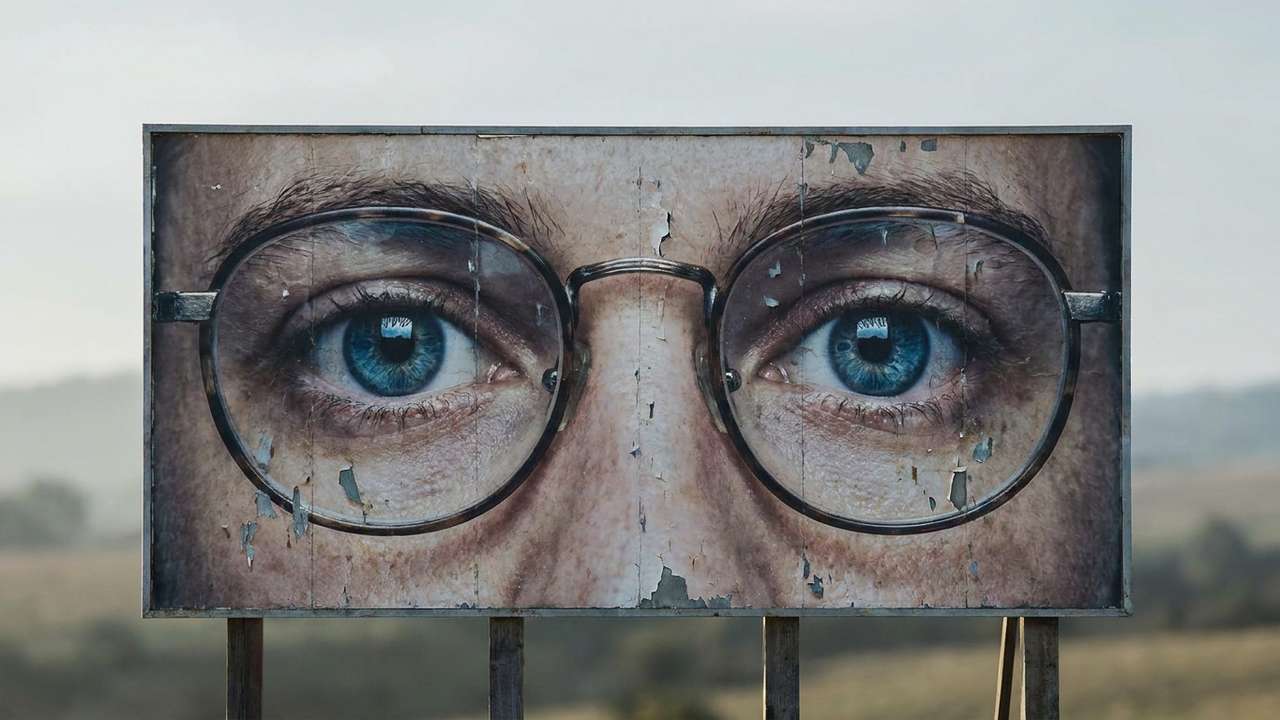
The eyes of T.J. Eckleburg are a faded advertising billboard in F. Scott Fitzgerald’s The Great Gatsby, and their most important attribute is that they symbolize the moral blindness and decay of the American Dream in the 1920s. This giant pair of bespectacled blue eyes, painted on a forgotten optometrist’s sign, watches over the “valley of ashes” and has fascinated readers for nearly a century. If you have ever asked what do the eyes of T.J. Eckleburg symbolize, you are joining one of the richest debates in American literature. This guide breaks down every major interpretation, the historical context behind the billboard, how different characters read the eyes, and the details that make this symbol so powerful.
Definition and Meaning: What the Billboard Eyes Represent
The eyes of T.J. Eckleburg represent the loss of spiritual values in a materialistic world. Fitzgerald describes the billboard as a pair of gigantic blue eyes, framed by yellow spectacles, staring down from a faded sign in the industrial wasteland between West Egg and New York City. The eyes are not real; they are paint on a crumbling advertisement. That is exactly the point. The eyes of T.J. Eckleburg symbolize a false god watching over a spiritually empty society.
Fitzgerald introduces the symbol early in the novel, when Nick Carraway travels with Tom Buchanan into the valley of ashes. The billboard looms above the ash heaps, and Nick describes the eyes as “brood[ing] on over the solemn dumping ground.” The optometrist who once owned the sign, T.J. Eckleburg, has long since forgotten it. The advertisement was meant to sell eyeglasses, but it has become something else entirely: a silent witness to moral decay.
Readers should understand several basic layers of meaning before diving into deeper interpretations:
- The eyes represent the decay of the American Dream, which has become hollow and commercial.
- They symbolize the absence of God, or a God who watches but does not intervene.
- They stand for moral judgment, though the judgment never actually arrives.
- They reflect the emptiness of advertising and consumer culture in the 1920s.
- They mirror the characters’ guilt and their desperate need for meaning.
Each of these layers works together. Fitzgerald never explains the symbol directly. He lets the billboard sit there, watching, and lets the reader decide what those giant eyes mean. That ambiguity is what makes the eyes so memorable and so widely studied in classrooms around the world.
The Eyes as a Substitute for God and Moral Judgment
The eyes of T.J. Eckleburg function as a substitute for God in the novel’s moral landscape. This is the most famous interpretation, and it comes directly from George Wilson, the grieving garage owner in the valley of ashes. After his wife Myrtle dies, Wilson looks out his window at the billboard and tells Michaelis, “God sees everything.” The eyes of the billboard are all that remains of divine oversight in a world that has abandoned faith.
George Wilson and the “God Sees Everything” Moment
Wilson’s statement is one of the most quoted lines in American literature. He does not say the billboard is God, but he treats it as a stand-in for divine witness. In his grief and confusion, the only face that watches him from the ash heap is a painted advertisement. The scene reveals that the novel’s world has no real moral authority left. The church is absent, the law is corrupt, and the only thing looking down on the characters is a commercial sign.
An Unblinking Witness That Never Acts
The billboard’s eyes never react. They do not stop Tom’s cruelty, Myrtle’s death, or Gatsby’s murder. They simply watch. This passivity is central to the symbol’s power. A traditional God judges and intervenes; the eyes of Eckleburg only observe. The result is a terrifying suggestion: in a secular, consumer-driven society, moral awareness survives, but moral action does not.
Consider how this plays out in the plot:
- Tom Buchanan takes Nick to the valley of ashes, and the eyes watch as Tom’s affair unfolds.
- Myrtle is killed by Daisy’s car near the billboard, and the eyes remain unchanged.
- George Wilson stares at the sign and decides that God has spoken through it.
- Wilson kills Gatsby and then himself, and the billboard keeps watching the aftermath.
Each event passes beneath the same gaze, and nothing about the eyes changes. That unchanging stare is the novel’s quiet argument that the old moral order has collapsed.
The Decay of the American Dream
The eyes of T.J. Eckleburg symbolize the corruption of the American Dream. The billboard was once a hopeful advertisement for an optometrist named T.J. Eckleburg. Over time, rain, soot, and neglect faded the sign until only the eyes remained. That transformation mirrors the journey of the dream itself: what began as an optimistic promise has decayed into a hollow shell.
The valley of ashes is the physical setting for this decay. It is an industrial dumping ground where the poor live and where the wealthy throw away what they no longer want. The billboard sits above this wasteland, an advertisement no one reads anymore, selling a product no one needs. The dream of self-improvement has become a faded sign.
| Element | Original Intention | What It Has Become |
|---|---|---|
| The billboard | An advertisement for eyeglasses | A forgotten monument to consumerism |
| T.J. Eckleburg | A successful optometrist | A name on a sign, absent from the story |
| The valley of ashes | A place of industry and progress | A graveyard of wasted lives and waste products |
| The eyes | A message about vision | A symbol of moral blindness |
The irony runs deep. An optometrist’s advertisement should promote clear vision, yet the society it overlooks cannot see its own corruption. Gatsby cannot see that his dream is hollow. Tom cannot see the damage he causes. Daisy cannot see beyond her own comfort. The eyes that “see everything” are surrounded by people who see nothing clearly.
Moral Blindness, Vision, and the Irony of the Optometrist
The eyes of T.J. Eckleburg symbolize moral blindness because they belong to an advertisement for corrective lenses. This is one of Fitzgerald’s sharpest ironies. The characters in The Great Gatsby fail to see what matters most, and the one symbol associated with vision belongs to a man and a business that no longer exist.
Nick Carraway, the narrator, claims to be honest and observant, yet he misses key truths until the end. Gatsby builds an elaborate vision of the future based on an illusion. Tom hides his affairs behind a mask of respectability. Daisy retreats into money and carelessness. Everyone is looking, and almost no one truly sees.
The Yellow Spectacles
The billboard’s spectacles are rimmed in yellow, a color the novel repeatedly connects with wealth and corruption. Daisy is associated with gold and white; Gatsby’s parties are bright with yellow light; the valley of ashes is filled with the yellow dust of industry. The yellow glasses attempt to correct vision, but they are part of the same tainted world they frame. The eyes see through a lens of money and social status, which distorts everything.
Who Watches Whom
The characters sense the eyes in moments of guilt. Myrtle looks at the billboard when she is with Tom. Wilson calls on the eyes as if they are a divine witness. The eyes serve as a kind of mirror: they show the characters what they refuse to see in themselves. The blindness on display is moral, not physical, and the symbol makes that distinction impossible to miss.
The Eyes in Different Contexts and Interpretations
The eyes of T.J. Eckleburg carry different meanings depending on which character encounters them and which critical lens the reader applies. The symbol is flexible enough to support several interpretations at once, which is why it appears in classrooms, essays, and literary discussions across many cultures.
Cross-Cultural Readings
In American literature classrooms, the eyes are usually taught as a symbol of God and the decline of the American Dream. In many Christian traditions, the eyes of Eckleburg evoke the “all-seeing eye” of God, similar to the Eye of Providence on the American one-dollar bill. In secular and Marxist readings, the eyes are pure commercialism: a sign that sells eyeglasses while watching over exploited workers. In psychological and dream readings, the eyes represent the superego or the conscience that never stops watching.
Readers should note that these interpretations do not cancel one another. Fitzgerald’s symbol is deliberately open. The eyes can be God, the market, the conscience, or all three at once. Each culture that studies the novel tends to emphasize the reading that speaks to its own concerns.
Symbol in the Novel’s Structure
The eyes appear near the novel’s most important turns. Fitzgerald places the billboard in the valley of ashes, a place characters must pass through to reach the city. The eyes therefore mark the transition between the innocent world of the Egg communities and the corrupt world of New York. In structural terms, the billboard is a threshold image, appearing when characters move from illusion toward consequence.
- Early chapter: the eyes first appear as a grim detail of the landscape.
- Middle chapters: the eyes watch over the affairs and secrets of Tom and Myrtle.
- Climax: the eyes remain in view during the fatal accident.
- Aftermath: Wilson interprets the eyes as God and takes revenge.
This pattern shows that the eyes do not belong to a single moment. They belong to the whole arc of the story, and their meaning grows as the characters’ illusions collapse.
Comparing the Eyes with Other Symbols in The Great Gatsby
The eyes of T.J. Eckleburg work best when compared with the novel’s other symbols, because each one carries a different part of the book’s message. The green light, the valley of ashes, and the eyes are often studied together, and each has a distinct role. The eyes focus on judgment and moral decay, while the green light focuses on hope and longing.
| Symbol | Core Meaning | How It Relates to the Eyes |
|---|---|---|
| Eyes of T.J. Eckleburg | Moral decay and the absence of divine judgment | The central symbol of failed oversight |
| Green light | Hope, longing, and the unreachable dream | What Gatsby stares at, while the eyes stare at everyone |
| Valley of ashes | Industrial waste and social inequality | The ground beneath the eyes and the setting of the symbol |
| Yellow spectacles | Wealth and distorted vision | The frame that makes the eyes look like a judge |
The green light is personal and hopeful; the eyes are collective and judgmental. Gatsby stretches his arms toward the light across the water, longing for Daisy. The eyes look down at the ash heap, watching what that longing costs. Together, the two symbols show the novel’s central contrast: the private dream and the public cost.
A useful comparison exercise is to ask what each symbol is looking at. The green light is something Gatsby looks toward. The valley of ashes is something the characters drive through. The eyes are something the characters feel but rarely understand. The symbol’s power comes from its position: everyone sees the billboard, and the billboard sees everyone.
Common Misconceptions and Misreadings
Many readers misunderstand the eyes of T.J. Eckleburg in predictable ways. The most common mistake is treating the eyes as God rather than as a symbol of God’s absence. Fitzgerald never confirms that the billboard is a divine presence. Wilson believes God is watching through the sign, but the novel’s tone suggests something more troubling: the eyes are all that is left of moral authority, and they are empty.
Other frequent errors include the following:
- Assuming T.J. Eckleburg is a character who appears in person. He is only a name on a sign.
- Believing the eyes judge the characters fairly. They watch, but they never pass sentence or intervene.
- Thinking the symbol has one fixed meaning. It supports multiple readings, and Fitzgerald keeps them in tension.
- Ignoring the advertising context. The billboard is a marketing sign first and a symbol second.
- Confusing the eyes with the green light. They are separate symbols with different roles.
A good practical rule is to read the billboard scene in context. Notice the ash, the faded paint, and the characters’ discomfort. The setting tells you what the eyes mean. They are a reminder that a society obsessed with appearance and profit has lost the ability to see clearly.
Frequently Asked Questions
What do the eyes of T.J. Eckleburg symbolize in one sentence?
The eyes symbolize the moral decay and spiritual emptiness of a society that has replaced faith and meaning with commercialism, while still feeling watched by something it can no longer believe in.
Are the eyes of T.J. Eckleburg God?
They are not literally God. They function as a symbol of God’s absence or as a false god. George Wilson treats them as a divine witness, but the novel never confirms that any divine power exists behind them. The eyes watch without acting, which is the point of the symbol.
Why does Fitzgerald call the eyes “blue and gigantic”?
The description makes the billboard feel supernatural and larger than life. The blue color suggests something heavenly or transcendent, while the enormous size makes the eyes impossible to ignore. The effect is a mock-religious image built from advertising paint.
What is the valley of ashes, and why does it matter?
The valley of ashes is the industrial wasteland between West Egg and New York City, where the billboard stands. It symbolizes the human and environmental cost of the wealthy characters’ lifestyles. The eyes watch over this waste, connecting the symbol to social inequality and decay.
How does the eyes symbol connect to the American Dream?
The billboard was once an advertisement for an optometrist, a symbol of opportunity and self-made success. Its faded condition mirrors the corruption of the American Dream, which in the novel becomes an empty pursuit of wealth and status rather than a genuine promise of a better life.
Do readers in other countries interpret the eyes differently?
Yes. Readers raised in religious traditions often focus on the divine judgment reading, while readers in secular or materialist traditions emphasize advertising and class. The symbol’s cross-cultural usefulness lies in this flexibility, and teachers around the world use it to discuss the costs of materialism.
Why and How to Teach and Study This Symbol Today
Studying the eyes of T.J. Eckleburg matters because the symbol speaks directly to modern concerns about surveillance, advertising, and moral responsibility. A giant sign that watches everyone but answers to no one is an image that resonates in an age of billboards, social media, and personal branding. The novel asks whether anyone is truly watching, and it offers a disturbing answer: only the market is watching, and it does not care.
For students and teachers, a practical study routine works well:
- Read the billboard passages closely and underline every mention of eyes, vision, and watching.
- Compare Wilson’s “God sees everything” line with the novel’s overall treatment of religion.
- Trace when the eyes appear in the plot and what is happening at each moment.
- Discuss the advertising context and the irony of an optometrist’s sign guarding a blind society.
- Write a short comparison of the eyes and the green light, noting how each symbol frames Gatsby’s dream.
A strong essay should move past listing meanings and instead argue for a position. For example, a writer might claim that the eyes matter less as a picture of God than as a picture of us: a society that wants to be seen, judged, and forgiven without ever being asked to change.
As a final note, remember that Fitzgerald gives no last word on the billboard. The eyes remain in the valley of ashes, watching long after the plot ends. The empty gaze is the message, and it is why readers keep returning to the question of what the eyes of T.J. Eckleburg symbolize.
Final Thoughts
The eyes of T.J. Eckleburg remain one of the most durable symbols in American fiction because they hold several truths at once. They stand for God’s absence, moral blindness, the decay of the American Dream, and the dead weight of commercial culture. The billboard was meant to sell eyeglasses; Fitzgerald turned it into a mirror for a society that can see everything except itself. Understanding the symbol helps readers see how the novel’s plot and its themes lock together, and it gives any reader a sharper lens for the world outside the book as well.