
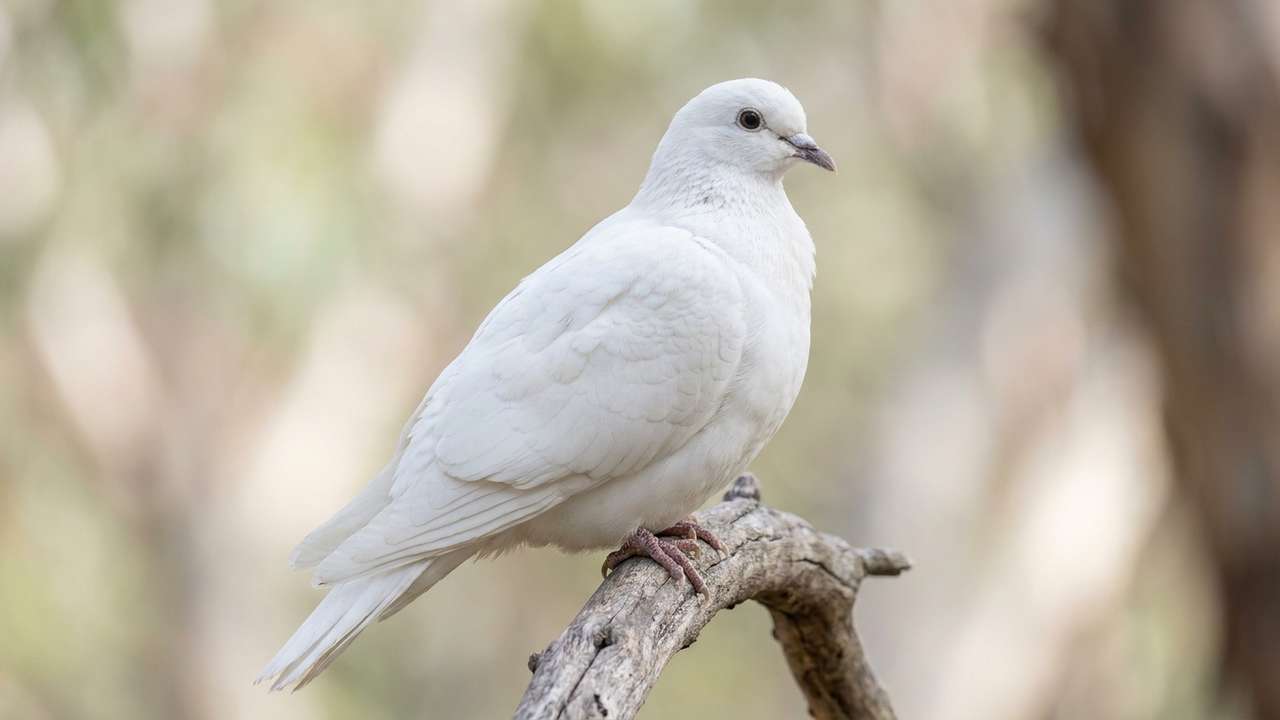
A white dove symbolizes peace, purity, love, and hope, and it carries that meaning in art, religion, and everyday life across most of the world. Few animals carry so much meaning with so little effort: a small white bird with a soft coo has become the shorthand for everything from a wedding vow to a peace treaty to a grief that has no words.
When people ask what do white doves symbolize, the short answer is peace and purity, but the full answer depends on where you are standing, what you believe, and what the bird is doing in that moment. A dove released at a wedding means something different from a dove carved on a gravestone, and a white dove in China does not read the same way as a white dove in Italy. This guide walks through the core meanings first, then the color, the religions, the cultures, the wedding and funeral traditions, the bird itself, and the myths that need correcting, so you can read the symbol accurately in any context you meet it.
The Core Meaning of White Doves: Peace, Purity, and Hope
A white dove symbolizes peace, purity, innocence, love, and hope, and it is one of the rare symbols that reads as positive almost everywhere it appears. The bird’s gentle nature, soft coloring, and quiet cooing have made it a natural stand-in for calm and goodwill for thousands of years, long before any single culture claimed it.
The peace meaning is the one most readers are looking for, and it has a clear modern anchor. In 1949 the artist Pablo Picasso created a dove lithograph for the World Peace Congress in Paris, and that image became the visual emblem of the postwar peace movement. Since then the white dove with an olive branch has appeared on posters, coins, stamps, and protest banners, and the association stuck so firmly that most people now see peace before they see anything else.
The other core meanings layer on top of that. A white dove stands for the following ideas in ordinary, everyday use:
- Peace and reconciliation — the end of conflict, a truce, a fresh start between two people or two nations.
- Purity and innocence — the white plumage does the work here, signaling something unspoiled or sincere.
- Love and fidelity — doves pair for long stretches and are famously devoted, which is why they show up at weddings.
- Hope and new beginnings — the bird returning with an olive branch after a flood is the original “things will be okay” image.
- The soul or spirit — in religious art a dove often represents something invisible and sacred taking visible form.
What makes the white dove unusual is how broadly these meanings travel. A lion means courage in Europe and something else entirely in parts of Asia. A white dove means peace in a school hallway in Ohio, in a church in Ethiopia, and on a poster at a United Nations event, with almost no translation needed.
Why the White Color Deepens the Dove’s Meaning
The color white adds the attributes of purity, cleanliness, sincerity, and new beginnings to the dove’s existing meaning, which is why a white dove reads as more ceremonial than a gray or brown one. A dove alone suggests gentleness; a white dove suggests gentleness plus something sacred.
Think about how that plays out in practice. A wedding planner releases two white doves, not two gray ones, because white signals a clean slate and a promise made in good faith. A hospice logo uses a white dove rather than a mourning dove because white suggests release and light rather than heaviness. A memorial program prints a single white dove in the corner because the color says “at peace” without a single word of text.
White also carries a built-in tension that is worth understanding. In Western Europe and North America, white is the color of brides, baptisms, and celebrations. In much of East Asia, white is the traditional color of mourning and funerals. The same bird, in the same color, can therefore land as a joyful omen in one country and a solemn farewell in another. That is not a contradiction in the symbol itself; it is a reminder that color does half the talking, and the listener’s culture decides what it hears.
Religious and Spiritual Symbolism of White Doves
In religious contexts, a white dove symbolizes divine presence, divine approval, and the movement of the spirit, and it holds a formal role in several major traditions rather than just a decorative one. The bird appears in scripture, in liturgy, and in sacred art, which is why it feels familiar even to people who have never opened a religious text.
| Tradition | Where the white dove appears | Core meaning |
|---|---|---|
| Christianity | The Spirit descending like a dove at the baptism of Jesus; the dove returning to Noah with an olive leaf; Pentecost imagery | The Holy Spirit, peace, baptism, divine blessing |
| Judaism | The dove and olive branch in the Noah story; the dove as an image of the beloved in the Song of Songs | Peace, deliverance, love, the People of Israel |
| Islam | Doves are generally treated with respect and are linked in popular tradition to the protection of the Prophet during the migration to Medina | Divine protection, gentleness, peace |
| Hinduism | The dove appears in poetry and art as a bird of love and longing; white carries associations of purity and of mourning | Devotion, tenderness, farewell |
| Buddhism | Doves appear in peace ceremonies and in the practice of releasing captive birds as an act of merit | Compassion, gentleness, liberation |
| Ancient Greece and Rome | Doves pulled the chariot of Aphrodite and Venus and were sacred to both goddesses | Love, beauty, desire, fertility |
| Modern secular use | Picasso’s 1949 dove for the World Peace Congress; the “peace dove” in Chinese is 和平鸽 | Peace, disarmament, human solidarity |
Christianity: The Holy Spirit and the Olive Branch
The Christian dove carries two stories at once. In the Gospel of Luke, the Spirit descends on Jesus like a dove at his baptism, which is why the bird shows up on baptismal fonts, confirmation certificates, and church ceilings. In Genesis, a dove returns to Noah with an olive leaf, signaling that the flood is ending, which is where the dove-and-branch image comes from. Christian art also uses a dove to represent the soul, especially the soul of a saint or martyr rising free of the body. The Latin word for dove, columba, was so strongly associated with the church that the Irish missionary Saint Columba took it as his name.
Ancient Greece and Rome: Aphrodite’s Bird
Long before the peace movement, the dove belonged to Aphrodite in Greece and Venus in Rome. Both goddesses of love were shown with doves, sometimes in their hands and sometimes pulling their chariots. That older association explains why the dove still appears on Valentine’s Day cards and wedding invitations: its romantic meaning is older than its pacifist one, and both meanings survive side by side.
White Doves in Different Cultures and Traditions
The meaning of a white dove varies by culture: in most of Europe and the Americas it signals peace and celebration, while in parts of East Asia white is a funeral color, so the same bird can read as a sign of mourning and farewell. Anyone treating the white dove as universally lucky is missing half the picture.
- China — the dove is called the peace dove (和平鸽), a term tied to modern peace imagery, and the bird is generally seen as gentle and auspicious. White itself, however, belongs to funerals, so context matters.
- Japan — white carries both sacred and mourning associations, appearing in Shinto ritual and in funeral settings, so a white dove can read as either blessing or farewell.
- Korea — traditional mourning dress is white, which gives white objects a solemn undertone even when the bird is meant as a symbol of peace.
- Eastern Europe and Russia — a widespread folk belief holds that harming a dove brings misfortune, and that a dove appearing at a window can announce a death in the family. This is folklore, not doctrine, but it is still repeated.
- Western Europe and the Americas — the white dove is overwhelmingly positive: peace, weddings, baptisms, memorials, and goodwill campaigns.
- Mediterranean and Middle Eastern cultures — the dove is a bird of love and poetry as much as politics, inherited from Greek and Roman imagery.
The lesson is practical. If you are designing a logo, a card, or a ceremony for an international audience, the white dove will almost always be read warmly, but a white dove in a funeral or memorial design aimed at East Asian viewers is not a mistake; it is a cultural fit. When the meaning differs by culture, the best move is to know which reading your audience will reach for first.
Love, Marriage, and the White Dove Release Tradition
In romantic and wedding contexts, a white dove symbolizes faithful love, a promise kept, and the start of a shared life, which is why the bird appears on invitations, cake toppers, and ceremony programs. The dove’s reputation for pairing and staying with a mate does most of the symbolic work here, and the wedding release simply turns that idea into a visible moment.
A modern dove release usually follows a recognizable pattern, and each step carries a piece of the meaning:
- The couple holds a pair of white doves, one each, representing two people entering the ceremony as individuals.
- They release the birds together, which symbolizes the start of the marriage as a shared act rather than a solo one.
- The doves often circle overhead before heading home, which guests read as a blessing hovering over the couple.
- Some couples release a single dove in memory of a parent or relative who could not be present, which shifts the meaning from celebration to remembrance.
- The birds return to their loft rather than flying away forever, a detail that quietly reinforces the idea of fidelity and homecoming.
One practical detail matters here. The white birds used at weddings are almost always white homing pigeons, a color variety of the rock dove, trained to fly back to their loft. True white ringneck doves cannot navigate home and are sometimes sold for releases anyway, and those birds commonly struggle or die after the event. If you are booking a release, ask the handler one direct question: do these birds fly home? A professional says yes and can explain the training. A seller who cannot answer is selling you a photo opportunity at the bird’s expense.
White Doves in Grief, Memorials, and the Afterlife
In grief and memorial settings, a white dove symbolizes the release of the soul, the end of suffering, and a peaceful farewell, and it is one of the most common images on gravestones, memorial cards, and hospice materials. The bird lifts and disappears, which is exactly the movement that mourners are trying to describe and cannot.
Picture a funeral where the family releases a single white dove at the graveside. The bird rises, circles once, and is gone. Nobody in that moment needs the symbol explained. The gesture says the person has been let go, that the family trusts the journey, and that something gentle has taken the place of something heavy. The same logic explains why a dove is carved on so many headstones and printed on so many memorial programs, and why the dove appears in Christian art flying from the mouth of a dying saint: it is the soul, leaving.
This is also where the cultural split becomes visible. In much of East Asia, white is already the color of mourning, so a white dove at a funeral needs no translation at all. In the West, white at a funeral reads as purity and peace rather than grief itself. Both readings land in the same place: the bird is doing the work of comfort.
Variations: White Doves, Gray Doves, and Pigeons Compared
The meaning changes with the bird, and the white dove’s symbolism belongs specifically to the white plumage and the ceremonial role, not to every bird in the dove family. A mourning dove is not a white dove, and a street pigeon is not a symbol of peace even though it is a close relative.
| Bird | Scientific name | Typical use | Symbolic meaning |
|---|---|---|---|
| White homing pigeon | Columba livia (white variety) | Wedding and memorial releases; trained to return to a loft | Peace, love, release, homecoming |
| White ringneck dove | Streptopelia risoria | Cage bird and decorative bird; poor navigator | Gentleness, domestic calm |
| Mourning dove | Zenaida macroura | Wild bird across North America; grayish brown, not white | Grief, longing, the sound of solitude |
| Rock pigeon (gray) | Columba livia | City bird, the ancestor of all domestic pigeons | Ordinary urban life, endurance, sometimes pest |
| White dove in art and religion | Symbolic, not a species | Painting, sculpture, logos, scripture | Peace, Holy Spirit, the soul, purity |
Dove or Pigeon: What Is the Difference?
The words “dove” and “pigeon” describe the same family of birds, Columbidae, and the distinction is largely one of size and habit rather than biology. Smaller, gentler species usually get called doves, and larger, stockier ones get called pigeons. That means the white bird released at a wedding is technically a pigeon, even though every guest will call it a dove, and the label does not change what it means. The symbolism lives in the white feathers and the ceremony, not in the taxonomy.
Common Misconceptions About White Doves
Most confusion about white doves comes from treating a symbol as a species, and the corrections are simple once you separate the bird from the meaning. A few of these myths travel widely enough that they deserve a direct answer.
- “A white dove is its own species.” White doves are a color variety, usually of the rock dove or the ringneck dove. There is no species called the white dove.
- “Released doves fly off to live in the wild.” Trained release birds fly home to their loft within a day. Untrained white ringneck doves released at events often do not survive.
- “A white dove always means peace.” It means peace in most Western and international contexts, but in parts of East Asia the white color pulls the meaning toward mourning and farewell.
- “Seeing a white dove is always a good omen.” Many people read a dove sighting as reassurance or comfort, and that reading is personal and cultural. In some folk traditions a dove at a window is instead a warning or a sign of death.
- “The dove symbol is modern.” The peace dove as a political emblem is modern, dating to the mid-twentieth century, but the bird’s religious and romantic meanings are thousands of years old.
Keeping these apart protects you from two opposite mistakes: dismissing the symbol as empty decoration, and treating it as a fixed code with one correct answer. It is neither. It is a flexible image that people reach for when a feeling needs a shape.
Frequently Asked Questions About White Dove Symbolism
What does it mean when a white dove visits you?
Most people read a white dove landing nearby as a sign of peace, reassurance, or a message from someone they have lost, and the meaning is emotional rather than scientific. There is no factual answer to what a bird “means” when it lands, but there is a very real human answer: the sighting gives a feeling a place to land. If the bird arrives during a hard week, most traditions would read that as comfort rather than warning.
Do white doves symbolize death?
Sometimes, yes. In parts of East Asia, white is the traditional mourning color, so a white dove at a funeral or in a memorial design reads as a symbol of death and farewell. In some European folk traditions, a dove appearing at a window is said to foretell a death in the household. In most Western contexts, though, a white dove at a funeral means peace, release, and the soul, not death itself.
What does a white dove symbolize in the Bible?
In biblical imagery, the dove signals peace after judgment, as in the Noah story, and divine presence, as at the baptism of Jesus when the Spirit descends like a dove. It also appears as an image of the beloved and of the soul. Outside of religious settings, most people simply carry the peace meaning forward without the theology attached.
Is a white dove the same as a white pigeon?
Yes, in practice. Doves and pigeons belong to the same bird family, and the white birds used in releases are white homing pigeons trained to return to their loft. The word “dove” carries the ceremony and the symbolism; the bird underneath is a pigeon.
Are white doves good luck?
In most of Europe, the Americas, and international peace imagery, a white dove is a strongly positive sign and is often treated as good luck. In cultures where white is a funeral color, the same bird carries a more solemn weight. The safest reading is that the dove signals peace and sincerity, and the luck part depends on who is reading it.
What does a white dove tattoo symbolize?
A white dove tattoo usually represents peace, freedom, love, faith, or the memory of someone who has died, and the design details shape the meaning. A dove with an olive branch points to peace, a dove in flight points to freedom or release, and a dove paired with a name or date points to remembrance.
Conclusion: Why the White Dove Still Matters
The white dove works as a symbol because it manages to say several things at once without contradicting itself. It is peace in a protest poster, love on a wedding invitation, faith in a baptism scene, and comfort on a memorial card. Its meaning shifts with the color of the culture around it, and that flexibility is a strength rather than a flaw: the bird gives people a shared image for feelings they would otherwise struggle to name.
Understanding what a white dove symbolizes also makes you a better reader of the world around you. You notice when a logo leans on peace, when a ceremony leans on release, and when a white bird in an East Asian design is doing something different from what a Western viewer assumes. Keep the core meanings in mind, stay curious about the context, and the next white dove you see, on a card, in a painting, or above a garden, will carry a little more weight than it did before.