
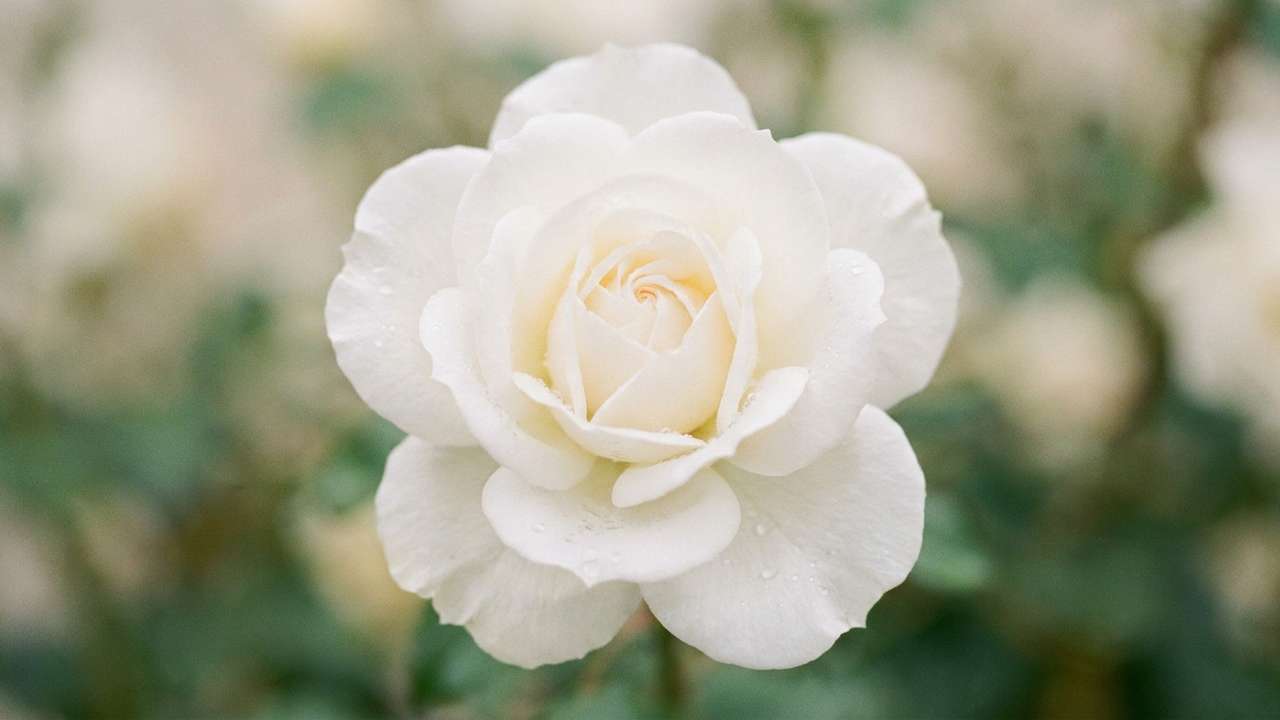
What do white roses symbolize? A white rose symbolizes purity, innocence, and new beginnings, and it is the only rose color that can express love, reverence, and farewell at the same time. That single flower carries more layers of meaning than almost any other bloom in the garden, which is exactly why people keep asking about it before they send a bouquet, plan a wedding, or write a sympathy card.
The problem is that most quick answers stop at “purity and innocence” and leave you with more questions than you started with. Does a white rose mean the same thing at a funeral as it does at a wedding? Why do some cultures treat white flowers as joyful and others treat them as mournful? How does the shade of white, the variety of rose, or the number of stems change the message? This article answers all of that in one place. You will learn the core meaning, the historical roots, cultural differences across the world, spiritual and religious layers, occasion-by-occasion use, how color variations shift the message, and the misconceptions that trip people up.
What White Roses Symbolize at Their Core
A white rose is a symbol of purity, and that attribute drives almost every other meaning attached to it. Purity here is not only romantic or religious. It also means honesty, sincerity, a clean slate, and a feeling with nothing hidden behind it. White roses symbolize purity, innocence, new beginnings, and sincere love, and they carry no romantic gender or gender expectation the way red roses often do.
Because white is the color of blank paper and untouched snow, the flower naturally reads as a fresh start. That is why white roses appear at weddings, christenings, housewarmings, and new jobs. The same blank-page quality makes white roses the standard choice for apologies and reconciliation. When words have failed, a white rose says “let’s begin again” without arguing about who was right.
The most common meanings people attach to white roses are:
- Purity and innocence — the classic and most widely recognized meaning.
- New beginnings — a fresh start, a fresh chapter, a clean slate.
- Sincere, honest love — love without games or hidden motives.
- Reverence and remembrance — respect for someone who has passed.
- Peace and calm — a wish for harmony after conflict.
- Secrecy and confidentiality — an old European tradition discussed later in this article.
- Eternal loyalty — a bond that does not fade.
A useful way to think about it is this: red roses shout, and white roses speak quietly. The white rose is the rose you choose when the message needs to be gentle, respectful, or honest rather than dramatic.
Where White Rose Symbolism Comes From
White rose symbolism began in the ancient Mediterranean, and the flower’s early meanings were religious and political before they were ever romantic. The white rose is one of the oldest cultivated rose groups. Botanists classify it under Rosa alba and related species, and gardeners in Greece, Rome, and the Near East were growing pale roses long before hybrid teas existed.
In ancient Rome, the rose was linked to Venus, the goddess of love, and to the idea of pleasure and celebration. Romans also painted or hung roses above tables and doors during private meetings. The Latin phrase sub rosa, which means “under the rose,” signaled that whatever was said in that room stayed in that room. From that custom comes the modern phrase “sub rosa” meaning in secret or confidentially, and it is one of the reasons white roses became associated with discretion and trust.
In medieval England, the white rose became a political badge rather than a romantic one. The House of York used a white rose as its emblem, while the House of Lancaster used a red rose. The series of civil wars fought between them from 1455 to 1487 took the name the Wars of the Roses. Later, the Tudor rose combined both colors to represent unity after the conflict.
The white rose also became a symbol of courage in the twentieth century. A student resistance group in Munich during the Nazi era called itself the White Rose, and its members, including Hans and Sophie Scholl, distributed leaflets opposing the regime in 1942 and 1943. Because of that history, a white rose can also read as a quiet but firm stand for conscience.
Three historical threads therefore feed the modern symbol:
- The Roman and Greek link between roses and love, beauty, and confidential speech.
- The medieval European use of the white rose as a dynastic and political emblem.
- The modern association with moral courage and peaceful resistance.
How Different Cultures Read White Roses
White rose meaning changes with culture, and the biggest split is between celebrations of purity and expressions of mourning. In Western countries, white roses are dominant at weddings and baptisms. In much of East Asia and parts of South Asia, white is the traditional color of funerals and mourning, so the same flower can feel somber rather than festive.
This is the single most important thing to check before sending white roses internationally or to someone from a different cultural background. A bouquet that feels elegant and joyful in London may feel like a condolence gift in Beijing or Tokyo.
| Culture or Region | Common White Rose Meaning |
|---|---|
| Western Europe and North America | Purity, weddings, sincere love, new beginnings |
| China | Mourning and funerals; white is traditionally the color of death and grief |
| Japan | Devotion, silence, and respect; also used in sympathy and memorial arrangements |
| India and Nepal | Purity and peace, but white flowers are also standard at funerals and memorial rites |
| Middle East and North Africa | Respect, admiration, and celebration; white roses are common in bridal arrangements |
| Latin America | Purity, weddings, and religious devotion; heavily used in church and first-communion settings |
| Russia and Eastern Europe | Deep respect and formal congratulations; also common at memorials |
The pattern is clear: where white is a bridal color, the rose reads as joy. Where white is a funeral color, the rose reads as remembrance. Neither reading is wrong, and both are genuine traditions rather than recent marketing inventions.
Spiritual and Religious Meanings of White Roses
White roses carry spiritual meaning in several faith traditions, and in each one the meaning grows directly out of the color’s association with purity and the divine. Because the rose is a flower of beauty and the color white represents cleanliness and light, religious writers have used the white rose as a bridge between human devotion and the sacred.
Christianity
In Christian tradition, the white rose is linked to the Virgin Mary, who is sometimes called the Mystic Rose. White roses appear in churches at Easter, at Christmas, and at baptisms, where they represent a purified soul and a new life in faith. The medieval poet Dante ended his Divine Comedy with an image of a vast celestial white rose formed by the souls of the blessed, which shows how deeply the flower had entered European religious imagination.
Islam
In Islamic tradition, roses in general are associated with the Prophet Muhammad and with the beauty of paradise, and white blooms are often used in that context to suggest purity and spiritual cleanliness. A white rose given as a gift can therefore carry both affection and a respectful, almost devotional tone.
Buddhism and Hinduism
In Buddhist and Hindu practice, white flowers symbolize purity of mind, humility, and the clearing away of desire. Devotees offer white flowers at temples and shrines, and the flower’s short life is a reminder of impermanence. Because of this, a white rose sits comfortably alongside white lotuses and jasmine in religious offerings.
Judaism
In Jewish wedding tradition, white flowers decorate the huppah, the marriage canopy, where they stand for joy, purity, and the clean beginning of a shared life. White roses are a common choice because they hold their shape in warm rooms and photograph cleanly under indoor light.
What White Roses Mean by Occasion
A white rose means different things depending on the occasion, and the same bouquet can be appropriate for a wedding, a funeral, or an apology because the flower’s core message of sincerity fits all three. The occasion sets the tone, and the white rose adapts to it better than any other rose color.
Weddings
White roses are the most traditional wedding flower in Western culture. Brides carry them to represent purity and a new beginning, and florists pair them with greenery, cream roses, or blush roses to keep the arrangement from looking stark. A white rose bouquet also photographs well in both bright daylight and dim reception halls.
Sympathy and Funerals
White roses are a standard sympathy flower because they express respect without the heaviness of dark colors. A single white rose placed on a casket or handed to a grieving family member says “I honor this loss” without needing a long message. In many Asian funeral traditions, white flowers are not just acceptable but expected.
Romance and Apology
White roses work in romantic settings when the message is devotion rather than passion. They are a common choice for a long-term partner on an anniversary, and they are widely used to apologize after a serious disagreement, because the white bud reads as a clean slate. If you want the message to be “I love you and I am sincere,” a mix of white and red roses covers both ideas at once.
Celebrations and Milestones
White roses suit graduations, retirements, new babies, housewarmings, and promotions because each of those events is a beginning. A practical example: a small bouquet of five or six white roses with eucalyptus makes an elegant, gender-neutral gift for an office colleague’s promotion, where pink or red might look too personal.
The Traditional Meaning of Rose Counts
Traditional floristry assigns meaning to the number of stems, though these are conventions rather than rules:
- One white rose — love at first sight, or a simple, honest declaration.
- Three white roses — a sincere “I love you.”
- Six white roses — a wish for harmony and a steady relationship.
- Twelve white roses — gratitude, or a formal expression of devotion.
- A full arrangement of white roses — a shared, lasting bond or a formal tribute.
How Shade, Variety, and Form Change the Meaning
White rose meaning shifts with shade, variety, and bloom stage, because each of those attributes adds its own layer to the base message. Pure white is the most formal and the most religiously charged. Cream and ivory soften the message into warmth. Blush-edged whites push the meaning toward romance.
Shades of White
- Pure white — purity, formality, reverence, weddings, and funerals.
- Cream or ivory — gentle love, nostalgia, warmth, and lasting affection.
- Blush white with pink edges — grace and sweet admiration, a softer romantic note.
- White with red edges — unity, partnership, and two ideas joined together.
- Green-white or aged white — renewal, and in some readings, gratitude.
Varieties You Will Actually See
Gardeners and florists work with a handful of named white roses, and each variety has a different look and a slightly different feel. Rosa alba varieties are the historic, heavily perfumed whites of old European gardens. The Iceberg rose is a famous modern white floribunda known for clusters of small blooms. Hybrid tea whites such as Pascali produce the long, single, formal stems you see in florist bouquets. Spray roses give many small heads on one stem, which suits table arrangements.
| Variety Type | Typical Look | Best Use |
|---|---|---|
| Rosa alba and old garden whites | Loose, fragrant, informally shaped blooms | Heritage gardens, wedding petals, scent |
| Iceberg floribunda | Clusters of small white blooms on bushy plants | Hedges, mass planting, garden borders |
| Hybrid tea white | One large bloom per long stem | Formal bouquets, single-stem gifts |
| White spray roses | Several miniature blooms per stem | Table centerpieces, boutonnieres, corsages |
Bloom Stage and Condition
A tight white bud reads as hope and anticipation. A fully open white rose reads as openness and honesty. A dried or pressed white rose reads as remembrance and permanence, which is why dried white roses appear in memorial crafts and in keepsake frames. In general, the more open the flower, the more the meaning leans toward sincerity and acceptance rather than new possibility.
White Roses Compared with Other Rose Colors
White roses differ from other rose colors mainly in emotional temperature, because white sits at the neutral, honest end of the spectrum while red, pink, and yellow push toward specific and louder feelings. Knowing the contrast helps you pick the right color on the first try.
| Rose Color | Primary Meaning | When to Choose It |
|---|---|---|
| White | Purity, sincerity, new beginnings, remembrance | Weddings, funerals, apologies, formal events |
| Red | Passionate romantic love | Valentine’s Day, romantic anniversaries |
| Pink | Admiration, gratitude, gentle affection | Thank-you gifts, Mother’s Day, new friendships |
| Yellow | Friendship, joy, and in some readings, apology | Platonic gifts, congratulations, get-well wishes |
| Orange | Enthusiasm, desire, bold energy | Celebrations, promotions, high-energy gifts |
| Lavender | Enchantment, wonder, love at first sight | Early romance, unique bouquets |
| Deep red or near-black | Devotion, mystery, final farewells | Dramatic statements, mourning in some traditions |
The practical summary is simple. If you want passion, choose red. If you want honesty, respect, or a clean beginning, choose white. If you want both, combine them in one arrangement, a pairing that florists often call a unity bouquet.
Common Misconceptions About White Roses
White roses are widely misunderstood, and most of the confusion comes from a single meaning being treated as the only meaning. The most persistent myth is that white roses always signal death or mourning. In reality, white roses appear at weddings, births, and graduations far more often than at funerals in Western countries.
Here are the misunderstandings worth correcting:
- “White roses mean death.” They mean remembrance in funeral settings, but the flower itself is neutral and joyful in weddings and celebrations.
- “White roses mean friendship only.” That is closer to yellow roses. White roses can carry sincere romantic love.
- “White roses are boring.” They are the most versatile rose color and the easiest to pair with any palette.
- “White roses are always the cheapest.” Price depends on variety, stem length, season, and farm source, not on color alone.
- “White roses are safe for every culture.” In China, Japan, and parts of India, white flowers are strongly tied to mourning, so check before sending them as a celebration gift.
- “White roses fade first.” Some white varieties bruise easily, but many whites are bred for long vase life, and handling matters more than color.
Correcting these myths matters because sending the wrong flower is an easy mistake to make and an awkward one to undo. The white rose is flexible, but it is not context-free.
Frequently Asked Questions About White Roses
Do white roses mean love?
Yes, but a specific kind of love. White roses express sincere, honest, enduring love rather than fiery passion. They suit long-term relationships, marriage, and devotion, which is why they dominate wedding work.
Are white roses appropriate for a funeral?
Yes, they are one of the most appropriate choices. White roses express respect, purity, and remembrance without the heavy emotional weight of dark red or black-toned flowers, and they are standard in sympathy arrangements worldwide.
What does a single white rose mean?
A single white rose traditionally means love at first sight, or a simple and honest declaration of feeling. It can also mean a quiet, respectful farewell when placed on a grave or handed to a grieving person.
What is the difference between white and cream roses?
Pure white roses read as formal, pure, and reverent. Cream and ivory roses read as warm, nostalgic, and gently affectionate. The difference is subtle, but cream is usually the friendlier and more casual choice.
Can I give white roses to a friend?
Yes. White roses suit platonic gifts well when the occasion is a new beginning, such as a new job, a new home, or a graduation. If you want the gift to read clearly as friendship, pair them with yellow roses.
What do white roses mean in China and Japan?
In China and Japan, white flowers are strongly associated with mourning and funerals. White roses given for a birthday or anniversary in those cultures can unintentionally feel like a condolence gesture, so choose a different color unless the occasion is a memorial.
Do white roses have a scent?
Some do, and a few do not. Old garden whites such as Rosa alba varieties are prized for strong fragrance, while many modern hybrid teas bred for long stems and shipping durability have little scent. If fragrance matters, ask your florist for a fragrant white variety by name.
Final Thoughts on White Rose Symbolism
White roses symbolize purity, innocence, sincerity, and new beginnings, and they carry those meanings across weddings, funerals, apologies, and celebrations without contradiction. The flower’s power comes from its restraint: it says what needs to be said without exaggeration, which is why it has stayed meaningful for more than two thousand years.
Understanding white rose symbolism helps you send the right message the first time, whether you are choosing a bridal bouquet, honoring someone you have lost, or repairing a relationship with a simple gesture. Pick the shade, the variety, and the number with care, respect the cultural context of the person receiving them, and the white rose will do the rest. Few symbols in nature are this quiet and this eloquent at the same time.