
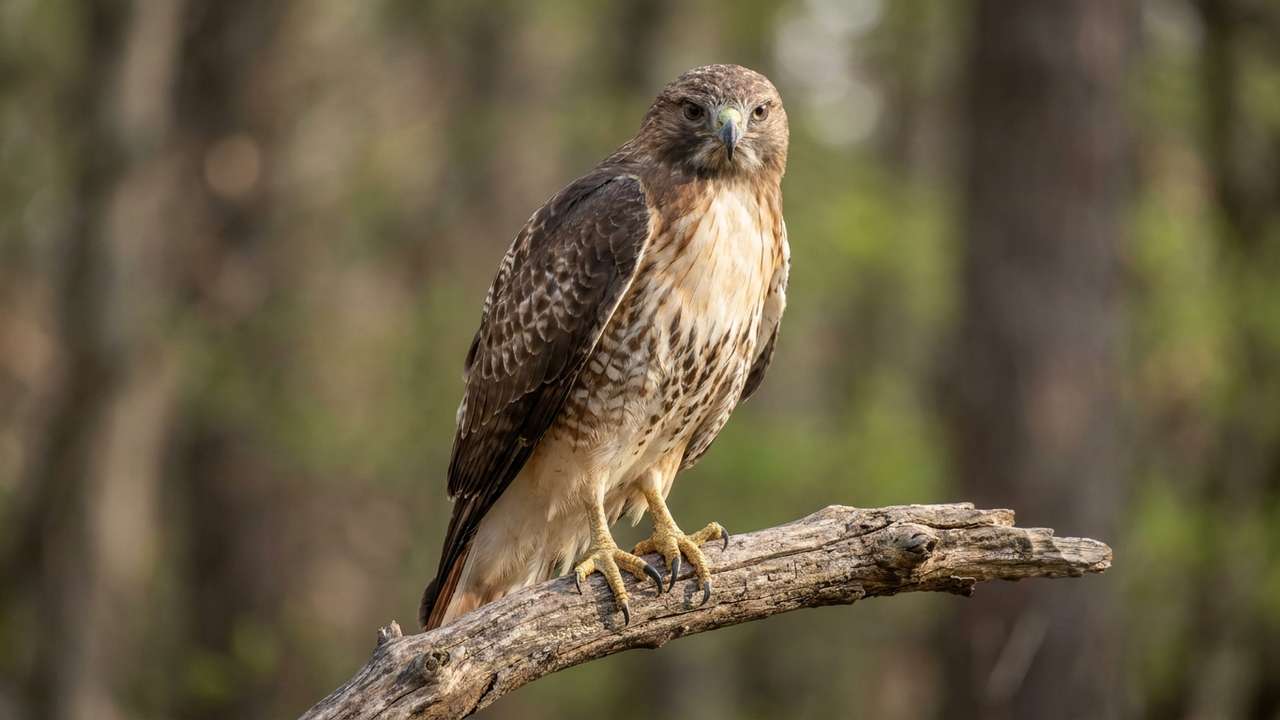
A hawk is a bird of prey whose symbolism centers on sharp vision, decisive power, and the freedom to rise above a situation. Nearly every tradition that pays attention to the hawk reads it the same way first: as a creature that sees what others miss and acts the moment it commits. That single idea — clarity before action — sits underneath almost every hawk meaning you will ever encounter.
People search for what does a hawk symbolize when one circles above a highway on their morning commute, when a hawk keeps appearing during a difficult season of life, when they are designing a tattoo or a brand identity, or when they simply want to know why the bird has always been treated with such respect. This guide covers all of it. You will learn the core meaning of the hawk, the vision-and-perception reading that dominates the symbolism, the power and independence angle, cultural interpretations from Indigenous North America to East Asia, the spiritual and religious layers, how species and colors change the message, and the everyday situations where hawk symbolism actually shows up.
What the Hawk Symbolizes at Its Core
The hawk symbolizes perceptive intelligence — the ability to see a whole situation from a height and then strike with precision. Cultures separated by oceans and centuries keep arriving at the same three attributes: sight, speed, and sovereignty over its own space. A hawk does not scavenge, and it does not flock. It hunts alone, it watches far longer than it moves, and it commits completely when it finally does move.
That combination made the bird a natural metaphor for the human qualities people admire most. The hawk’s eye is the sharpest part of the story, and it is also the most useful: the bird can spot a mouse from a great height, track it without losing focus, and adjust mid-flight. Anyone who has watched a red-tailed hawk hold position in a crosswind understands why the bird became shorthand for concentration.
- Vision: the ability to see the big picture and the small detail at the same time.
- Decisive action: the courage to commit once the moment is right.
- Freedom and independence: a life lived on your own terms, without waiting for permission.
- Power with restraint: strength that stays quiet until it is needed.
- Guidance and messages: the sense that a larger perspective is being offered to you.
- Opportunity awareness: the habit of noticing what is available before it disappears.
One clarification matters here. The word hawk is a loose label rather than a strict scientific category. In North America it usually means a buteo such as the red-tailed hawk, while in other regions the same word can describe entirely different birds of prey. The symbolism, however, has stayed remarkably consistent across all of them, which tells you the meaning comes from how the bird behaves rather than from its exact species.
Vision and Clear Perception: The Most Common Meaning
Vision is the most common meaning of hawk symbolism. The hawk represents the ability to see a situation clearly from a distance, to separate what matters from what is merely loud, and to notice an opportunity before it vanishes. When people say a hawk appeared to them at a turning point, they almost always mean they were being nudged toward a clearer perspective.
This reading has deep roots in how the bird actually lives. A hawk spends the majority of a hunt watching rather than flying. It rises on a thermal, scans a field, and only drops when the target is certain. That patience-then-precision pattern is the emotional core of the symbol. It suggests that most problems are not solved by moving faster but by seeing better.
In practice, hawk vision translates into a simple four-step rhythm that anyone can borrow:
- Rise above the noise. Step back from the daily details long enough to see the shape of the whole situation.
- Scan widely before you narrow. Take in the full field of options instead of fixating on the first one that appears.
- Lock onto one target. Choose the goal that actually matters and let the rest go.
- Act without second-guessing. Once you commit, move with the full force of that decision.
Consider a manager who is deciding whether to shut down a failing product line. The instinct is to keep patching it, because patching is busy work that feels productive. The hawk reading says something different: get altitude, look at the whole portfolio, notice that the failing line is quietly consuming the resources that could fund a winner, and then cut it in one clean motion. That is not ruthlessness. It is the discipline of seeing clearly and acting once.
Power, Authority, and Independence
The hawk symbolizes power that is earned and self-contained rather than inherited or displayed. A hawk does not announce itself. It perches high, watches, and lets its presence do the talking. Because of that, the bird became a natural emblem for authority in many traditions — kings, chiefs, and warriors all used hawk imagery to signal that their strength came from competence rather than ceremony.
This is also the attribute that carries the hawk into everyday language. In political writing, a hawk is someone who favors firm, confrontational action, while a dove favors negotiation. In financial and economic commentary, a hawkish stance means a preference for tighter policy and higher rates to control inflation. In both cases the bird lends its image to a specific kind of resolve: the willingness to act firmly even when the choice is unpopular.
Independence is the softer side of the same attribute. Hawks are solitary hunters, and they do not gather in flocks the way pigeons or starlings do. That solitude turns the bird into a symbol of self-reliance — of people who trust their own judgment, work best without a crowd, and would rather carry a decision alone than dilute it with consensus.
It is worth saying plainly that this attribute can be read negatively. A hawk in pursuit is a predator, and some traditions treat the bird as a warning about cold self-interest or about someone who takes what is not theirs. Farming communities in Europe and North America have long associated a hawk near the henhouse with plain, practical loss. The symbol holds both readings: the focused leader and the opportunist who exploits.
Hawk Symbolism Across Cultures and Traditions
Hawk symbolism differs by culture, and the differences are worth knowing because they change how you should read the bird in a particular setting. Broadly, traditions that admire the warrior and the messenger treat the hawk as noble and auspicious, while traditions shaped by farming and livestock treat it more warily.
| Culture or tradition | Primary meaning | How the hawk is understood |
|---|---|---|
| Indigenous North American nations | Messenger, foresight, guardian | Meanings vary by nation; the red-tailed hawk is often a protective figure and a carrier of prayers, and hawk feathers frequently appear in ceremonial regalia. |
| Ancient Egypt | Divine sight, kingship, the sun | Egyptian artists usually depicted a falcon rather than a true hawk, most famously in the falcon-headed god Horus, whose eye stood for wholeness and perception. |
| Ancient Greece | Swift pursuit, prophecy, the sun | Hawks appear in Greek fable and omen lore as fast, confident hunters linked to Apollo, the god of prophecy and light. |
| Celtic traditions | Insight, pride, the otherworld | Welsh and Irish stories feature hawks as sharp-sighted, proud figures associated with knowledge that ordinary people cannot reach. |
| Norse and Germanic art | Battle, nobility, vigilance | Birds of prey decorate weapons and armor as images of the warrior’s eye and the speed of a decisive strike. |
| China | Ambition, heroic aspiration | The word for hawk, ying, sounds like the word for hero, which made the bird a natural visual pun for ambition and greatness in painting and poetry. |
| Japan | Martial skill, nobility | Hawk motifs appear on samurai armor, sword fittings, and folding screens as symbols of alertness and refined strength. |
| Christian Europe | Watchfulness, the soul’s ascent | Medieval bestiaries used the hawk as an image of the soul rising toward higher things, though the dove and eagle carried more weight in official religious art. |
| Islamic and falconry cultures | Nobility, discipline, partnership | Centuries of falconry made the trained hawk and falcon emblems of patience, breeding, and the bond between hunter and bird. |
| Mesoamerica | Warrior courage, the sun | Aztec warrior orders took the eagle and hawk as emblems of bravery and solar power; the two birds were often grouped in art. |
Where the hawk is a messenger
In many Indigenous traditions, the hawk carries word between the human world and the spirit world. The bird flies high, sees far, and returns, which makes it a natural courier. A hawk appearing during a ceremony, a fast, or a moment of decision is often read as an answer rather than a coincidence.
Where the hawk is a warning
In farming folklore across Europe and North America, a hawk circling low over a yard is a plain signal that something vulnerable is nearby. That practical reading carried into superstition: a hawk near the home could mean a dispute, a loss, or a sharp-eyed person watching your interests. This is the honest counterweight to the more flattering readings, and it is part of why the bird feels powerful rather than merely pretty.
Spiritual and Religious Meaning of the Hawk
In spiritual terms, the hawk symbolizes a messenger between the everyday world and a larger order. The bird occupies two realms at once — it launches from the ground and hunts from the sky — so it became a natural bridge figure. Its meaning is not usually about escape from ordinary life. It is about carrying a clearer view back down into ordinary life.
The hawk as a spirit animal or totem
People who work with animal symbolism often describe the hawk as a guide for anyone entering a season that demands focus, discernment, or a hard decision. The attributes assigned to a hawk totem tend to cluster around a few traits:
- seeing through distraction to the real issue
- trusting intuition that arrives quickly and without explanation
- taking responsibility for your own direction
- speaking plainly rather than politely
- accepting that some choices must be made alone
Hawks in sacred texts and religious art
Religious texts mention the hawk mostly as a creature of the sky rather than as a central figure. The book of Job points to the hawk’s flight as a mark of natural wisdom, and the bird appears in dietary and purity laws as a bird of prey. In Christian art the dove and the eagle carry the heaviest symbolic load, which leaves the hawk as a secondary but recognizable image of watchfulness and upward movement. In Egyptian religion the falcon form is far more central, tied to kingship and to the integrity of sight.
Picture a woman on a silent retreat who has spent three days trying to decide whether to leave a job she has outgrown. On the fourth morning a hawk lands on the fence outside the chapel and stays for twenty minutes. She does not treat it as a command. She treats it as a prompt to stop circling the decision and look at it from above — and that shift is the entire point of hawk spirituality in practice.
Species, Color, and Form: How the Meaning Changes
The species, coloring, and artistic form of a hawk all shift its meaning slightly. The core reading of vision and power stays in place, but each variation adds a distinct accent, which is why two people can both say “a hawk” and mean quite different things.
Species differences
The red-tailed hawk is the most familiar hawk in North America and carries the broadest, most protective meaning. The Cooper’s hawk and sharp-shinned hawk are woodland hunters that specialize in taking other birds, so they read as symbols of agility, precision, and cleverness rather than raw force. The northern harrier hunts low over open fields and reads as patience and persistence. The American kestrel, technically a falcon but commonly grouped with hawks by the public, adds a note of quickness and small-scale courage.
Color and appearance
A dark-morph hawk reads as mystery and hidden power. A hawk with a bright rufous tail reads as visible confidence. A rare white hawk, which happens when a bird carries a genetic trait that reduces pigment, is treated in folklore as an unusually strong omen or a once-in-a-lifetime sign — partly because the bird itself is so uncommon.
How the hawk compares to other symbolic birds
Readers often confuse hawk symbolism with nearby birds, so the distinctions are worth setting out clearly.
| Bird | Core symbolic meaning | How it differs from the hawk |
|---|---|---|
| Hawk | Focused vision, decisive power, independence | Emphasizes precision and the single clean strike |
| Eagle | Majesty, national power, spiritual authority | Larger and more public; empire and divine favor rather than personal focus |
| Falcon | Speed, discipline, trained skill | Sleeker and faster; associated with partnership and craft |
| Owl | Wisdom, night knowledge, hidden truth | Sees in darkness rather than from height |
| Raven | Prophecy, transformation, trickery | Ambiguous and cunning rather than direct |
Form in art and design
A hawk in flight with wings spread reads as freedom and reach. A perched hawk with a lowered head reads as readiness and contained force. A hawk shown mid-strike reads as decisiveness. Tattoo artists and logo designers lean on these poses deliberately, because the posture carries more meaning than the species does.
Hawk Symbolism in Everyday Contexts
Most people meet hawk symbolism in ordinary situations rather than in a temple or a museum. The bird shows up on a drive to work, in a dream, on a jersey, or on a company logo, and the meaning in each case is slightly different.
- Seeing a hawk overhead: commonly read as a call to gain perspective and stop overthinking a decision that is already clear.
- A hawk landing nearby: often taken as a sign of undivided attention — a message that deserves to be noticed rather than explained away.
- A hawk in a dream: typically associated with ambition and clarity, though a hawk that attacks or chases can point to pressure or a threat the dreamer has been avoiding.
- A hawk tattoo: usually chosen for focus, independence, and the memory of a period when the wearer had to fight for their own direction.
- A hawk as a brand or team name: signals sharpness, speed, and competitive focus — which is exactly why sports teams and security firms use it.
- A hawk in a personal name: in several Indigenous naming traditions the bird’s name is conferred rather than self-chosen, and it signals a responsibility to live up to the bird’s qualities.
The one thing all of these contexts share is attention. A hawk is never a background detail. It interrupts, and the interruption is the message.
Common Questions About Hawk Symbolism
Is the hawk a good omen?
In most traditions, yes. The hawk is read as auspicious — a sign of clarity, protection, and timely action. The exception is contexts where the bird is seen as a predator near something vulnerable, which turns it into a warning rather than a blessing.
What does it mean when a hawk visits your yard?
Practically, it means your yard sits inside a hunting territory. Symbolically, many people read a repeated visit as a prompt to pay attention to what is directly in front of them. Both readings can be true at once.
Is hawk symbolism the same as eagle symbolism?
No. Eagles carry public majesty, national identity, and spiritual authority. Hawks carry personal focus, precision, and independence. The hawk is the smaller, sharper, more private version of the same family of meaning.
Does hawk symbolism differ from falcon symbolism?
Yes, though they overlap. Falcons emphasize speed and trained discipline; hawks emphasize patient watching followed by a decisive strike. Falconry traditions often treat the two birds as partners with different jobs rather than as rivals.
Can the hawk mean something negative?
It can. The hawk’s opportunism and its habit of taking smaller birds make it a symbol of predation, self-interest, and sharp dealing in some folklore. Political use of the word hawk also carries an aggressive edge.
Which hawk meaning should you choose?
Start with the context you met the bird in. A hawk during a difficult decision points toward vision and commitment. A hawk in a family or heritage setting points toward protection and ancestry. A hawk in art or branding points toward sharpness and competitive focus. The context narrows the meaning faster than any dictionary can.
Final Thoughts on Hawk Symbolism
The hawk carries one central message across nearly every culture that has ever watched it: see clearly, then act completely. Around that core meaning cluster the related attributes of power, independence, guidance, and opportunity, with cultural variation adding texture rather than contradiction. Where the bird is honored as a messenger, it lifts the reader upward. Where it is feared as a predator, it warns the reader to guard what is vulnerable. Both readings come from the same sharp eye.
Understanding hawk symbolism is worth the effort because it gives you a compact vocabulary for a very human challenge — the difficulty of stepping back far enough to see your situation clearly and then committing to one direction. Whether you arrived here because a hawk crossed your path this morning or because you are choosing a tattoo, a name, or a team identity, the bird offers the same advice it has always offered: get altitude, pick your target, and move.